
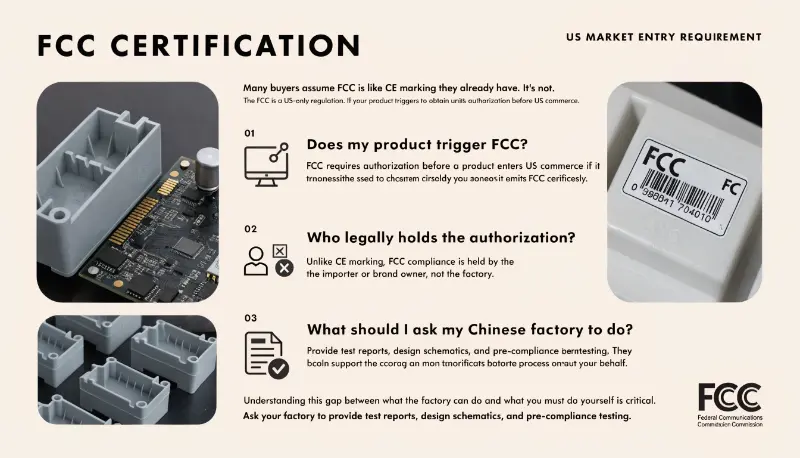
If you’re sourcing injection-molded electronic components in China and planning to sell in the United States, FCC certification is one of the first walls you’ll hit. Most buyers already have CE marks in hand and assume the US process works the same way. It doesn’t — and that assumption creates real delays.
FCC certification is a US market entry requirement that applies to specific product categories involving electronics, radio frequency emission, or digital circuitry1. Unlike CE marking, FCC compliance is held by the importer or brand owner — not the factory2. If your product triggers the requirement, you are legally responsible for obtaining authorization before the product enters US commerce. Your Chinese factory supports the process but cannot own the certificate on your behalf.
Understanding that gap — between what your factory can do and what you must do yourself — is what makes US market entry smoother. I’ve watched buyers send the wrong requests to the wrong people for months before getting this right. The sections below walk through the three decisions that matter most: whether your product triggers FCC requirements, who legally holds the authorization, and what to actually ask your factory for.
Does Your Product Require FCC Certification?
This is the question that derails European buyers most often, because the triggering logic is completely different from CE.
Most products that need CE marking are triggered by voltage, power, or machinery risk categories. FCC authorization is triggered by a different set of product characteristics — ones that your spec sheet answers if you know where to look. Before you engage a test lab or brief your factory, you need to make this call first.
The Three-Filter Check
Run your product through these three questions in order:
Filter 1: Does it plug into a power source or contain a battery?
If yes, it likely contains digital circuitry that generates clock signals. Most modern electronics — even ones without wireless features — fall here.
Filter 2: Does it intentionally transmit or receive radio frequency signals?
Bluetooth, Wi-Fi, Zigbee, cellular, RFID, NFC — all of these are intentional radiators. Products with any of these features have specific authorization requirements that go beyond basic electronic device rules.
Filter 3: Does it operate above 9 kHz using digital logic?
This is the threshold that catches products buyers often overlook: smart home devices, LED drivers with PWM control, motor controllers, and similar items that don’t "feel" like radio products but still generate RF emissions.
What the Filters Predict
| Product Type | Typical Trigger | Authorization Path |
|---|---|---|
| Bluetooth speaker | Intentional radiator | More specific authorization required |
| Plastic enclosure (no electronics) | None | No FCC requirement |
| Smart thermostat | Both digital circuitry + intentional radiator | More specific authorization required |
| LED light with PWM driver | Digital circuitry | Unintentional radiator rules apply |
| Medical monitor with display | Digital circuitry | Unintentional radiator rules apply |
| Pure mechanical part | None | No FCC requirement |
I’ve talked to product managers who spent weeks trying to figure out if their product needed FCC, when the answer was visible in the BOM on page one. If your component list includes a microcontroller, a wireless module, or a switching power supply, the answer is almost certainly yes.
Pure Plastic Parts Are Different
One thing worth saying clearly: if you’re sourcing injection-molded parts with no embedded electronics, no batteries, and no wireless capability, FCC certification doesn’t apply. A plastic housing for a medical device, a polypropylene cap, an ABS enclosure shell — none of these trigger FCC requirements on their own. The certification obligation follows the finished electronic product, not every component in it.
This matters for hardware startups especially. If you’re buying a molded enclosure from a Chinese factory and assembling electronics separately in the US, your certification obligation attaches to the finished assembly — and your factory’s role shifts accordingly.
Why CE Marking Doesn’t Transfer to the US
Almost every European buyer I work with asks some version of this: "We already have CE — why do I need to do FCC separately?"
It’s a fair question. The products are the same. The tests look similar on the surface. But the underlying legal structures are fundamentally different, and treating them as equivalent will get you into trouble at the US border.
CE marking is a self-declaration system built on EU directives. The manufacturer or EU-based importer assesses conformity, applies the mark, and maintains a technical file. Regulatory bodies don’t pre-approve CE marks — they enforce retroactively.
FCC authorization works differently. The FCC requires that electronic devices receive authorization before they’re marketed or imported into the United States. That authorization is tied to a specific legal entity — your US-registered company or your designated US agent — and it’s public record in the FCC database.
The Structural Gap Between CE and FCC
Here’s where buyers consistently get confused:
Scope of coverage: CE marking covers a family of directives — EMC, Low Voltage, Radio Equipment, etc. — and your Declaration of Conformity names which ones apply. FCC authorization is specific to RF emission and interference rules under US law. These are parallel systems that overlap in technical testing but differ in legal accountability.
Who holds responsibility: Under CE, the manufacturer or EU importer signs the declaration. Under FCC, the US importer or brand owner holds the grant of authorization. If you’re a European company importing to the US, you need either a US entity or a US agent registered with the FCC. Your Chinese factory cannot hold this on your behalf under normal circumstances.
Test report portability: Some test data generated for CE compliance may be usable in the FCC authorization process, depending on the accreditation of the lab and the test standards applied. But this is a conversation to have with your test lab — not an assumption to build your timeline around. I’ve seen buyers assume their CE test reports would cover FCC and lose months waiting for a lab to tell them they needed additional testing.
Database visibility: FCC grants are publicly searchable. When your product ships to the US, the importer of record can be cross-checked against FCC records. CE declarations are internal documents — no public database verification.
The bottom line is that CE experience gives you useful process intuition but misleading scope assumptions. Treat FCC as a parallel system, not an extension of what you already did in Europe.
Who Actually Owns FCC Compliance — And What to Ask Your Factory For
This is where the most expensive mistakes happen. Buyers send their factory a message that says something like, "Can you handle FCC certification for this product?" The factory says yes, something gets submitted, and months later the buyer realizes the certificate is under the factory’s name and can’t be transferred. Or the factory says no, and the buyer thinks they’ve hit a dead end.
Neither outcome is right. The question itself is wrong.
Your factory’s role in FCC compliance is real and important — but it’s not authorization ownership. Here’s how to think about the correct split.
What You Own
- The FCC grant of authorization (or your Declaration of Conformity, depending on authorization type)
- The relationship with the accredited test laboratory
- The US entity or US agent designation required for FCC purposes
- All correspondence with the FCC
What Your Factory Provides
Your factory’s job is to make the testing and documentation process possible. Specifically, you should request:
Test samples: Your accredited lab needs physical units to test. Your factory should allocate samples early in the product development cycle — not after tooling is locked and production has started. I always recommend requesting pre-production samples specifically flagged for lab submission.
Bill of Materials (BOM) disclosure: The test lab and your compliance consultant need to understand what’s inside the product — especially any modules, ICs, or wireless components. If your factory is reluctant to share full BOM data, that’s a project risk you need to surface early.
Design documentation: For products with wireless modules that already carry FCC authorization themselves (a common scenario with Wi-Fi and Bluetooth chipsets), your factory needs to provide integration documentation showing how the module is used in the final product. This supports the authorization process for the finished device.
Pre-compliance test support: Some buyers work with their factory to do informal pre-compliance testing before submitting to a formal lab. Your factory should be able to support this with internal QC testing or by working with a local test facility. It doesn’t replace formal lab testing, but it reduces the chance of failing at submission and restarting the clock.
Structuring the Request Correctly
Instead of asking "Can you handle FCC?", send a request that includes specific deliverables:
"We will manage FCC authorization through our US entity and an accredited test lab. We need: (1) five pre-production samples allocated for lab testing, (2) full BOM disclosure including all modules and chipsets, (3) design documentation for any wireless components, and (4) willingness to support pre-compliance testing coordination."
This reframes the conversation from a yes/no on certification to a concrete set of factory deliverables. Most experienced injection molding manufacturers — especially those exporting to the US — will understand exactly what you’re asking for.
Frequently Asked Questions
Can a Chinese factory hold the FCC certificate for my product?
Generally, no. FCC authorization is tied to the US importer or brand owner. In some cases, a manufacturer can hold authorization, but the entity responsible for placing the product in US commerce must be identifiable and accountable under US law. For most importers, the cleanest path is to hold the grant under your own US entity or through a designated US agent.
If my product has a Wi-Fi or Bluetooth module that’s already FCC-certified, do I still need certification?
Yes, typically. The module itself carries authorization, but the finished product — including how that module is integrated into your device — usually requires its own authorization. Your test lab or compliance consultant will tell you what documentation you need from the module manufacturer and what additional testing, if any, applies to your finished device.
Does FCC certification apply to every product I import into the US?
No. FCC requirements apply specifically to electronic devices that generate or use radio frequency energy. Pure mechanical parts, passive components, and non-electronic injection-molded products generally don’t trigger FCC requirements. If your product has no electronics, no battery, and no wireless function, you can likely skip this entirely.
How early in my product development should I start the FCC process?
As early as possible — ideally before tooling is finalized. Changes required after a test failure can mean tooling modifications, which are expensive. Raising FCC requirements during the design phase lets your engineering team and your factory plan for shielding, module placement, and sample allocation before production commitments are made.
What happens if I import a product into the US without required FCC authorization?
Products without required FCC authorization can be detained at the border, refused entry, or subject to enforcement action. Products already in market can be subject to recall or import alerts. This is not a minor compliance issue — it’s one of the few regulatory failures that can stop a product line entirely.
Conclusion
FCC certification is one of the most misunderstood parts of US market entry for buyers with European sourcing experience. The core issue isn’t technical — it’s structural. CE experience teaches buyers to think of certification as a factory deliverable. FCC authorization is a buyer responsibility, built on a legal framework that requires your US entity to own the outcome. Your factory’s role is real and necessary, but it’s defined by documentation and sample support — not certificate ownership.
Start with the product-type filter. Determine whether your product triggers FCC requirements before you engage anyone. Then structure your factory request around specific deliverables rather than asking them to "handle FCC." That single reframe eliminates most of the confusion I see at the inquiry stage.
If you’re preparing a US-bound product line and want to understand how our factory supports the documentation and sample allocation side of the compliance process, reach out. We’ve been exporting to the US market for over 20 years and we know exactly what your test lab will need from us.
-
"Equipment Authorization", https://www.fcc.gov/engineering-technology/laboratory-division/general/equipment-authorization. The Federal Communications Commission establishes equipment authorization requirements under Title 47 of the Code of Federal Regulations, covering devices that emit radio frequency energy, intentional radiators, and digital devices capable of generating RF interference. Evidence role: definition; source type: government. Supports: the regulatory categories of products subject to FCC equipment authorization requirements. Scope note: Regulatory definitions may not enumerate all edge cases or recent amendments ↩
-
"Equipment Authorization Procedures", https://www.fcc.gov/general/equipment-authorization-procedures. FCC regulations require equipment authorization applications to identify a grantee (typically the importer or brand owner placing the product on the US market), whereas CE marking under EU directives assigns conformity declaration responsibilities primarily to the manufacturer or authorized representative within the EU. Evidence role: general_support; source type: government. Supports: the designation of responsible parties under FCC rules and the contrast with CE marking obligations. Scope note: This captures the general framework but does not address all scenarios involving authorized representatives or distributors. ↩