You have a product idea. You are excited. But then a scary question hits you: how much will the first prototype cost? Guess too high and you scare yourself out of starting. Guess too low and you run out of money fast. This confusion stops many great products before they even begin.
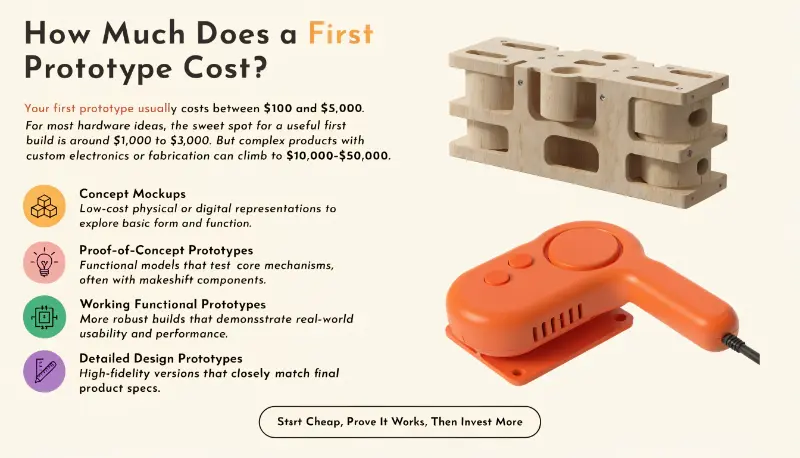
A first prototype usually costs $100 to $5,000, depending on whether you need a rough concept mockup or a working functional model. For most hardware ideas, the sweet spot for a useful first build is around $1,000 to $3,000. Complex products with custom electronics or fabrication can climb to $10,000–$50,000. Start cheap, prove the idea works, then invest more.
I have helped many founders build their very first prototype. Some spent too much on version one and regretted it. Others spent smart and saved thousands. In this article, I will show you real cost ranges, the four types of prototypes, and how to protect your idea without wasting money. Let’s dig in.
How Much Should a Prototype Cost?
Many founders ask me for one magic number. But there is no single price. A prototype can cost $50 or $50,000. Without a clear target, you either overspend or build something useless. This uncertainty causes stress and slows you down.
A prototype should cost only as much as it takes to answer one question: "Does this idea work?" For a first build, that often means under $1,000 using 3D printing and off-the-shelf parts. Functional prototypes with real materials run $500–$5,000. Pre-production models for investors or testing cost $2,000–$15,000. Advanced hardware with custom electronics can pass $10,000.
Here is a simple breakdown I share with my clients:
| Prototype Level | Cost Range | Best For |
|---|---|---|
| Proof of concept | $0–$500 | Foam, cardboard, simple 3D prints |
| Functional prototype | $500–$5,000 | Real parts, some engineering |
| Pre-production | $2,000–$15,000 | Investor demos, user testing |
| Advanced hardware | $10,000+ | Custom electronics, tooling work |
The biggest cost drivers are complexity, materials, and design work. More moving parts and tighter tolerances raise the price fast. Foam and stock parts are cheap. Metal, custom PCBs, and production-grade finishes cost much more. If you also need CAD or industrial design from scratch, add more to your budget.
My advice for your first version is simple. Spend the least amount needed to test your core idea. Build a rough version first. Then spend real money only after you know the concept works. This one habit has saved my clients thousands of dollars.
What Are the 4 Types of Prototypes?
Founders often think a prototype is just one thing. So they jump straight to an expensive, polished model. But that wastes money. You skip cheaper steps that could have caught big problems early. This mistake is very common and very costly1.
There are four main types of prototypes: proof of concept, visual (looks-like), functional (works-like), and pre-production. Each has a different job. A proof of concept tests one idea. A visual prototype shows the shape and feel. A functional prototype proves it works. A pre-production prototype matches the final product for testing before mass production.
Let me explain each type in plain words.
Proof of Concept
This is the roughest version. You use foam, cardboard, or a simple 3D print. The goal is only to prove your idea is possible. It does not need to look nice or work fully. Cost is often under $500.
Visual Prototype (Looks-Like)
This one shows the size, shape, and appearance. It looks like the final product but may not work inside. It is great for photos, marketing, and getting feedback on design.
Functional Prototype (Works-Like)
This version works but may not look pretty. It proves the product does its job. For electronics, this includes real circuits and code. This is where most engineering money goes.
Pre-Production Prototype
This is the closest to the final product. It looks and works like the real thing. You use it for user testing, investor demos, and to check your manufacturing plan.
| Type | Looks Like Final? | Works Like Final? | Typical Cost |
|---|---|---|---|
| Proof of concept | No | No | $0–$500 |
| Visual | Yes | No | $500–$3,000 |
| Functional | No | Yes | $1,000–$10,000 |
| Pre-production | Yes | Yes | $5,000–$25,000+ |
My tip: move through these types in order. Do not skip to pre-production first. Each step teaches you something and saves money later.
How Much to Develop a Prototype?
Development cost is where many founders get surprised. They plan for the parts but forget the labor. Design, engineering, and testing all cost money. Suddenly a "$1,000 prototype" becomes a $10,000 project. This shock can drain your budget fast.
To develop a prototype, budget for both materials and labor. Simple DIY prototypes cost under $1,000. Professional hardware development runs $10,000–$50,000 when it involves custom electronics and fabrication. Software or app prototypes cost $5,000–$20,000, depending on features and UI. Always add extra budget for two or three rounds of improvements.
Here is what shapes your development cost:
Who builds it. You have three choices. DIY is cheapest but slow and hard. Freelancers cost less than firms but need more management. Professional firms cost the most but bring speed and skill.
| Path | Cost Level | Speed | Risk |
|---|---|---|---|
| DIY | Lowest | Slow | High learning curve |
| Freelancers | Medium | Medium | Needs management |
| Pro firm | Highest | Fast | Lower technical risk |
Where you build it. Building overseas can lower costs. But I warn my clients: it often brings communication delays and quality problems. For your first prototype, staying close and hands-on is usually worth the extra cost.
Which tools you use. Rapid prototyping tools and open-source platforms like Arduino or Raspberry Pi cut costs a lot for electronics. 3D printing slashes the cost of physical parts. Use these whenever you can.
The smartest way to save money is to focus. Build only the essential features first. Skip fancy refinements. A first prototype is not the final product. It is a learning tool. And always set aside extra money, because the first version almost never works perfectly. Plan for at least two or three iterations.
Can You Patent an Idea with a Prototype?
Founders worry someone will steal their idea. So they rush to build a prototype and think it protects them. But a prototype alone does not give you legal rights. This false sense of safety can cost you your entire invention.
You cannot patent just an idea, but a prototype helps you patent your invention. A prototype proves your concept works and helps you explain it clearly in a patent application. However, the prototype itself is not the patent. You must file with a patent office. A prototype is strong evidence, not legal protection by itself.
Let me clear up the confusion. In the US, patents protect inventions, not vague ideas. Your invention must be new, useful, and not obvious. A prototype does not automatically grant these rights. But it does make your patent application stronger because it shows how the invention works.
Here are practical steps I share with founders:
- File a provisional patent. This is cheaper and gives you "patent pending" status for 12 months. It buys you time to test and improve.
- Use NDAs. Before showing your prototype to factories or freelancers, sign a Non-Disclosure Agreement. This protects your idea legally during development.
- Keep records. Save your sketches, dates, and design files. This proves you invented it first.
| Protection Tool | Cost Level | What It Does |
|---|---|---|
| NDA | Low | Stops others from sharing your idea |
| Provisional patent | Medium | Gives 12 months of "patent pending" |
| Full utility patent | High | Long-term legal protection |
One warning: adding IP protection raises your prototype cost a little. But it is worth it. I have seen founders lose their ideas because they skipped an NDA. Spend a small amount now to protect a big idea later. Talk to a patent attorney before you show your prototype widely.
Conclusion
A first prototype should cost only enough to answer one question: does your idea work? Start cheap, often under $1,000, then invest more after you prove the concept. Move through the four prototype types in order. Protect your idea with NDAs and a provisional patent. Ready to build smart? Start with a rough version today and scale with confidence.
-
"The Ultimate Startup Guide With Statistics (2024–2025)", https://ff.co/startup-statistics-guide/. Lean startup methodology and product development research emphasize that iterative prototyping and early user validation reduce waste by identifying design flaws before expensive tooling and production commitments, though specific cost-savings data varies widely by industry and product complexity. Evidence role: general_support; source type: research. Supports: the business case for iterative prototyping and early validation in reducing development costs. Scope note: While the principle of early validation is well-established in startup methodology, quantitative data on how frequently founders skip this step or the average cost impact is limited and context-dependent. ↩