
Home / Injection Mold Design & Manufacturing
TOOLING ENGINEERING
Injection Mold Design & Manufacturing
The tool must match the product geometry, resin, appearance, validation plan, expected output, maintenance approach, and commercial risk. We organize these choices into an approval-based tooling process.
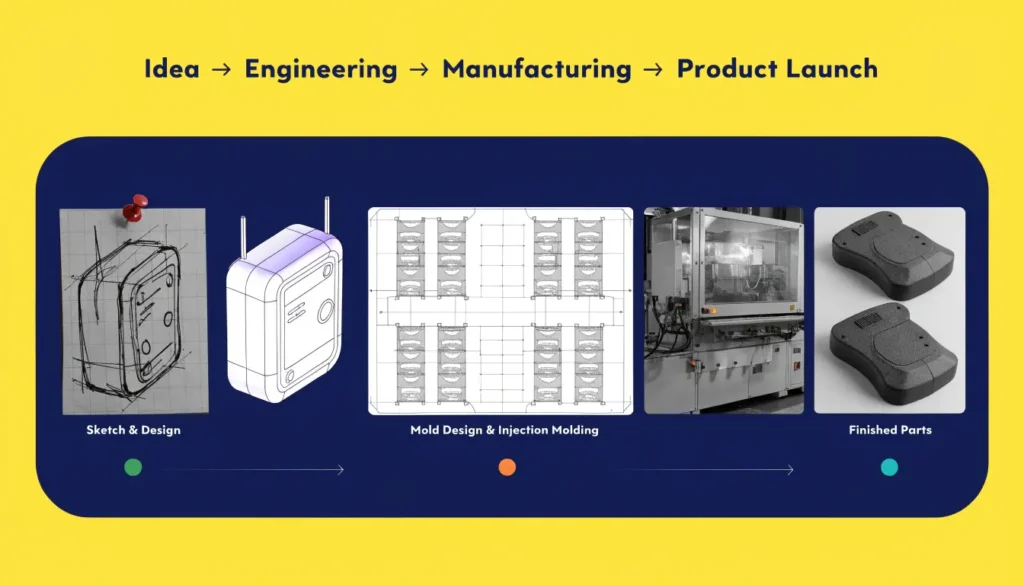
Tool structure decisions
Cavities
Single-cavity, multi-cavity, and family-mold concepts are compared against demand, balance, validation risk, and part economics.
Runner and gating
Cold- and hot-runner options are evaluated with resin, gate evidence, waste, cycle, tool complexity, and maintenance in mind.
Actions and release
Slides, lifters, inserts, shutoffs, ejection, and automatic release are selected around actual geometry and reliable operation.
Steel and tool life
Tool steel is not selected from one label or price point. The decision considers resin, additives, surface requirements, corrosion or wear exposure, planned output, repairability, and whether the tool is intended for validation or repeat production. The quotation should state the agreed tool construction rather than rely on a vague class name.
3D mold design approval
Before manufacturing begins, the mold concept and defined design outputs are reviewed. Customer approval confirms agreed interfaces and open decisions; it does not transfer responsibility for undisclosed product requirements.
- Part revision and orientation
- Parting, gating, ejection, and action concepts
- Insert and cooling considerations where applicable
- Tool interfaces and key dimensions
- Approved deviations, risks, and trial plan
T1, correction, and approval
T1 establishes evidence. Samples, process observations, and agreed inspection results are reviewed; corrections are categorized by process, tool, or product design. T2 or additional trials are scheduled when required. Production release happens only after the agreed approval criteria are met.
Maintenance and ownership
Tool maintenance, storage, ownership, release, export preparation, and change costs should be stated in the quotation or project agreement. See the dedicated ownership and IP page for the operating principles used during project review.
Frequently Asked Questions
Do I approve the mold design before machining?
The project plan identifies the mold-design approval point and the information supplied for review. Machining should not proceed past an agreed gate while critical decisions remain open.
Is a hot runner always better?
No. It can reduce runner waste or support a production strategy, but adds cost, controls, maintenance, and compatibility considerations. The correct choice depends on the program.
Who owns the mold?
Ownership and release terms are defined in the accepted quotation, purchase order, and any project agreement. Do not rely on an assumption; request the terms before ordering.
Related Resources
Reviewed by Jerry Zou · Last updated August 28, 2026
Technical recommendations for a live project depend on the submitted revision, exact material grade, quality requirements, quantity, and agreed scope.
Ready to review your molding project?
Send your files and project requirements. We will review the manufacturing path before you commit to tooling.