
Home / DFM & Moldability Review
ENGINEERING BEFORE TOOLING
Injection Molding DFM & Moldability Review
A focused DFM review turns a product model into a clearer tooling decision. We identify geometry and process risks, show where decisions are still open, and separate required changes from optional cost or appearance improvements.
What to send
A useful review starts with the latest revision, not screenshots.
- STEP or STP file for each molded part
- 2D drawing when tolerances, threads, inserts, texture, or inspection points matter
- Preferred resin or the performance requirements the resin must meet
- Part function, mating components, target market, initial quantity, and annual estimate
- Known cosmetic surfaces and any areas that cannot accept gates, ejector marks, or parting lines
What we check
Part geometry
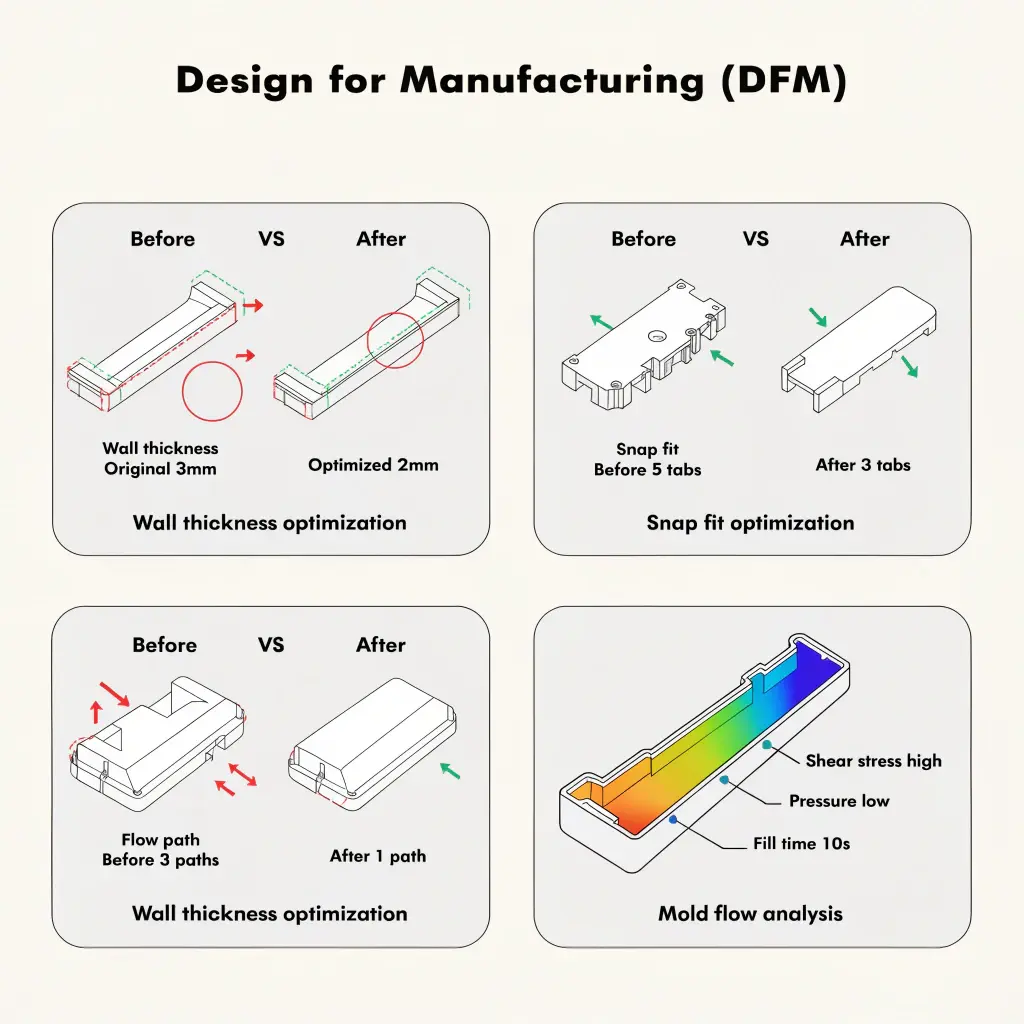
Wall transitions, draft, ribs, bosses, snap fits, shutoffs, undercuts, steel conditions, and features vulnerable to sink or distortion.
Tool interaction
Parting strategy, gate concepts, ejection, slides or lifters, insert access, venting considerations, and likely tool complexity.
Material and tolerance
Whether the stated material, shrinkage, stiffness, appearance, and tolerance expectations are compatible with the design intent.
What you receive
The exact format is agreed at quotation, but the review is intended to create an actionable decision record.
- Marked views or annotated findings tied to the submitted revision
- Risk level and rationale for each significant finding
- Recommended geometry or tooling response
- Questions that require customer approval
- A clear recommendation for prototype tooling, production tooling, or further design work
How DFM reduces risk before steel is cut
Changing a radius, draft angle, wall transition, gate position, or undercut strategy in CAD is usually more controllable than correcting a finished tool. DFM also gives product, tooling, quality, and procurement stakeholders one version of the manufacturing assumptions.
Good fit—and when to pause
Good fit
Near-final molded-part CAD, a working prototype moving toward molded validation, or an existing design that needs tooling-risk review.
Pause first
Concept sketches without usable geometry, projects that are clearly better suited to CNC or additive manufacturing, or designs whose functional requirements are not yet defined.
Frequently Asked Questions
Is the DFM review a final mold design?
No. DFM evaluates the part and manufacturing strategy. Detailed mold design follows after commercial scope and key DFM decisions are approved.
Will you change my CAD file?
Only if CAD modification is included in the agreed scope. A standard review can identify and explain changes without taking ownership of the product design.
Can you review an assembly with several molded parts?
Yes. Include the assembly, individual part files, mating requirements, and the dimensions that control fit or function.
Related Resources
Reviewed by Jerry Zou · Last updated August 28, 2026
Technical recommendations for a live project depend on the submitted revision, exact material grade, quality requirements, quantity, and agreed scope.
Ready to review your molding project?
Send your files and project requirements. We will review the manufacturing path before you commit to tooling.