
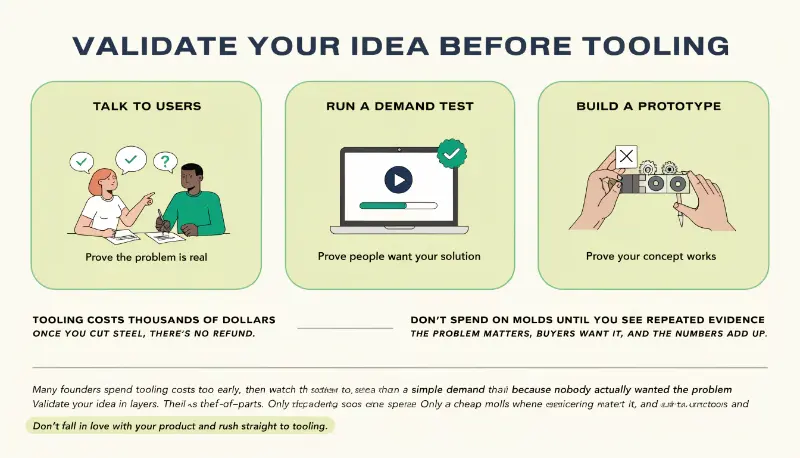
You have a great product idea. You can already picture the finished product on store shelves. But here is the scary part: tooling can cost thousands of dollars, and once you cut steel, there is no refund1. Many founders spend that money too early. Then they watch their dream fail because nobody actually wanted the product2.
Validate your idea in layers before spending on tooling. First, prove the problem is real by talking to users. Next, prove people want your solution with a simple demand test like a landing page or preorder. Then, build a cheap proof-of-concept using off-the-shelf parts to prove the concept works. Only spend on molds after you see repeated evidence that the problem matters, buyers want it, and the numbers add up.
I have watched too many startups skip these steps. They fall in love with their product and rush straight to tooling. In this guide, I will walk you through the exact order to validate your idea, what signals to look for, and how to avoid burning cash. Let’s start with the smart way to validate.
How Do You Validate Your Product Idea Before Launching?
Most founders build first and ask questions later. They spend months on a polished prototype, then discover nobody will pay for it. This is the most expensive mistake in hardware. Once your money is locked in tooling and inventory, it is very hard to change direction.
Validate your product idea before launching by proving three things: real demand, a clear target customer, and the features people actually care about. Use short customer interviews to confirm the problem is painful. Run a low-cost demand test, like a landing page or preorder page, to see if people will commit. Build a crude proof-of-concept to confirm the core function works. Do all this before you order any molds or fixtures.
Validation is not one big test. It is a series of small, cheap experiments. Each one lowers your risk before you spend the next dollar. Think of it like peeling an onion, one layer at a time.
Start With the Problem, Not the Product
Hardware ideas fail when they start with the product instead of the problem. Before anything else, write down who has the problem, how often it happens, and what it costs them today. If the problem is rare or easy to ignore, no amount of clever engineering will save you.
Test Demand Before You Build
You can test demand without a finished product. Put up a simple landing page with a "Reserve Yours" button. Watch how many people click and sign up. This tells you if the idea has real pull, not just polite interest.
| Validation Method | Cost | Time | What It Proves |
|---|---|---|---|
| Customer interviews | Free | 1-2 weeks | Is the problem real? |
| Landing page test | $50-$200 | 1 week | Do people want it? |
| Preorder/waitlist | $100-$500 | 2-4 weeks | Will people pay? |
| Proof-of-concept prototype | $200-$2,000 | 2-6 weeks | Does it work? |
| Tooling & molds | $5,000-$50,000+ | 2-4 months | Can you scale? |
Notice how tooling sits at the very bottom. It is the most expensive step, so it should always come last.
What Are the Steps in Validating an Idea?
Founders often feel lost when they hear "validate your idea." Where do you even start? Without a clear roadmap, many jump around randomly. They build a prototype before checking demand, or contact a factory before knowing if the product can be sold at a profit.
The steps in validating a hardware idea are: define the pain clearly, talk to likely users, test demand before building, build the cheapest possible proof-of-concept, check manufacturability with a rough bill of materials, review regulations and patents, and finally test small-batch production. Each step answers one key question and gets cheaper mistakes out of the way first. Skipping steps or doing them out of order usually just speeds up failure.
Let me break down each step so you know exactly what to do.
The Ten Practical Steps
- Conduct market research to check demand and find competitors.
- Create a low-fidelity prototype using off-the-shelf parts.
- Gather feedback through interviews, surveys, or usability tests.
- Evaluate technical feasibility with engineers or experts.
- Build a basic business model to estimate cost, price, and profit.
- Launch a crowdfunding or preorder page to test market interest.
- Assess regulatory compliance and needed certifications early.
- Test scalability and manufacturability with small batch runs.
- Validate supply chain reliability by contacting real vendors.
- Check patent and IP issues before investing in tooling.
Why Manufacturability Deserves Early Attention
Here is a step people skip too often: checking if the product can actually be built at a viable price. Make a rough bill of materials early. Add up part costs. If your BOM already looks too expensive for your expected selling price, you have a problem no amount of marketing can fix. I have seen ideas that worked perfectly in the lab but died because the parts cost more than customers would pay. Catch this before tooling, not after.
When Validating an Idea, What Is the Correct Order to Validate?
Order matters more than most people think. Do things in the wrong sequence and you waste money proving things that don’t matter yet. For example, perfecting your industrial design before confirming anyone wants the product is a classic and costly mistake.
The correct order is to validate from cheapest to most expensive, and from riskiest assumption to safest. First, prove the problem is real. Second, prove people want your solution. Third, prove the concept works cheaply. Fourth, prove it can be manufactured at a viable cost. Only then should you spend on tooling and mass production. This "layered" approach means your biggest expenses come only after your biggest risks are gone.
Think of validation like a funnel. Each layer removes a big unknown.
The Layered Validation Funnel
| Layer | Question Answered | Risk Removed |
|---|---|---|
| 1. Problem | Is this problem real and painful? | Building something nobody needs |
| 2. Desire | Do people want my solution? | Making a product with no buyers |
| 3. Concept | Can this actually work? | Technical failure |
| 4. Economics | Can I build it at a profit? | Unviable unit costs |
| 5. Scale | Can I produce it reliably? | Supply chain and quality issues |
Don’t Skip Layers to Save Time
I know the temptation. You want to move fast. But skipping a layer does not save time in the long run. If you jump to tooling before checking demand, you might spend $20,000 on molds for a product nobody buys. That is not fast. That is expensive and slow, because now you have to start over. Validate each layer in order, and let each one earn the right to move to the next.
What Is the First Thing You Should Do When Validating a Strategy?
New founders often want to build right away. Building feels productive. But the very first thing is not building at all, and skipping it leads straight to wasted months and empty bank accounts. The first mistake is falling in love with your solution before you understand the problem.
The first thing you should do is clearly define the pain and talk to real users. Write down exactly who has the problem, how often it happens, what it costs them, and what they do about it today. Then run short interviews focused on their workflow and frustrations. Do not pitch your solution too early. Your only job at this stage is to learn whether the problem is frequent, expensive, and urgent enough that people will pay to solve it.
Customer interviews sound simple, but most people do them wrong. Here is how to do them right.
How to Run Good Validation Interviews
- Ask about their past behavior, not future opinions. "What did you do last time this happened?" beats "Would you buy this?"
- Let them talk. You should listen 80% of the time.
- Avoid leading questions that push them to agree with you.
- Focus on the problem and their current workarounds, not your product.
Good Signals vs. Red Flags
Watch closely for these signals as you talk to people.
| Good Signals | Red Flags |
|---|---|
| Users describe the problem without prompting | People just say it’s "cool" but won’t commit |
| They use clumsy workarounds already | The problem is rare or easy to ignore |
| They join a waitlist or pay a deposit | Prototype only works in a demo, not real use |
| Your rough prototype solves the core job | The BOM is already too expensive |
A good rule of thumb: don’t pay for tooling until you have seen repeated evidence that the problem matters, the solution is wanted, and the unit economics can work. When users describe your problem in their own words and reach for their wallets, you are ready to move forward.
Conclusion
Validating a hardware idea is about lowering risk before spending big. Start with the problem, prove people want your solution, then build a cheap proof-of-concept. Check manufacturability and unit costs before you ever pay for molds. Follow this layered order, and tooling becomes a confident investment instead of a gamble. Ready to move from validation to a real prototype? Start with your cheapest experiment today.
-
"Calculated Risk: A Framework for Evaluating Product …", https://sloanreview.mit.edu/article/calculated-risk-a-framework-for-evaluating-product-development/. Injection mold tooling costs vary widely by complexity and material, commonly ranging from several thousand to hundreds of thousands of dollars, representing a largely non-recoverable capital expenditure once fabrication begins. Evidence role: statistic; source type: research. Supports: The typical cost range for injection mold tooling and the capital commitment involved before production begins. Scope note: Cost figures vary significantly by geography, part complexity, and material; a cited source may reflect a specific segment of the market rather than universal costs ↩
-
"Product Innovation: 95% of new products miss the mark", https://professionalprograms.mit.edu/blog/design/why-95-of-new-products-miss-the-mark-and-how-yours-can-avoid-the-same-fate/. Post-mortem analyses of startup failures consistently identify lack of market need as a primary cause of failure, suggesting that premature capital commitment before demand is confirmed is a recurring pattern across product ventures. Evidence role: general_support; source type: research. Supports: That insufficient market validation is a documented contributor to new product and startup failure. Scope note: Most cited failure analyses aggregate across software and hardware startups; studies isolating tooling-specific premature investment in hardware ventures are limited ↩