
Your hardware product’s certifications are determined by what the product is, what it does, and where you plan to sell it. There is no single certification package for every hardware product1 – and any resource suggesting so will mislead you right from the start.
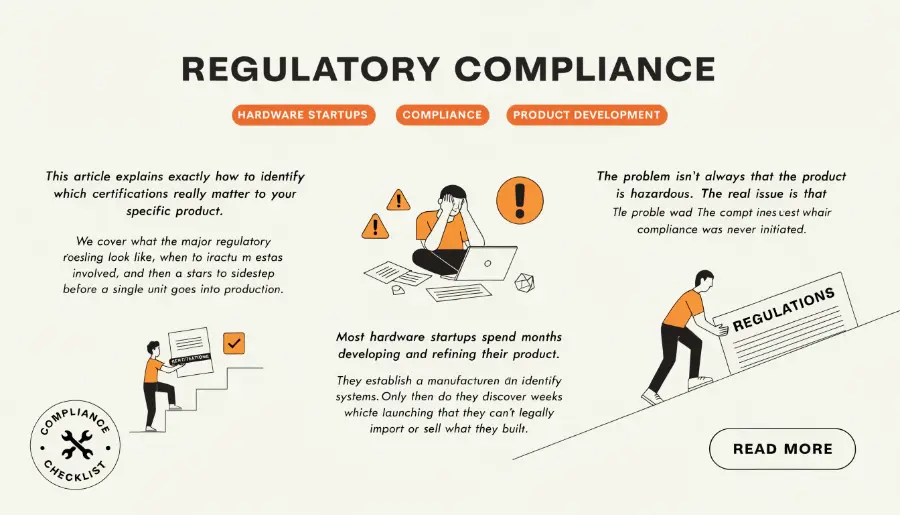
Here’s what happens to most hardware startups: they spend months developing and refining their product, establish a manufacturer, finalize the tooling and only then discover weeks before launching that they can’t legally import or sell what they built2. The problem isn’t always that the product is hazardous. The real issue is that compliance was never initiated. By that time, the damage is not just financial.
This article explains exactly how to identify which certifications really matter to your specific product, what the major regulatory systems looks like, when to start, the costs involved and what errors to sidestep before a single unit goes into production.
Why Hardware Product Certification Catches Most Founders Off Guard
Certification is one of the most expensive surprises in the development of a new hardware product. The requirements aren’t secret but most founders don’t really consider them until it’s far too late – and by then those errors are already expensive.
Each design choice has implications for compliance, which is why certification must be part of your product development process right from the very beginning, rather than being treated as the final step before launch.
Moreover, the type of wireless module you select, your battery chemistry, the material used in your enclosure and even the method of shielding your (PCB) will all have an impact on your certification requirements. If you make these decisions without ever considering regulatory compliance, you could end up with a product that cannot pass certification and only discover the problem after you have already invested in tooling.
The financial penalties can also be significant. In November 2024, the FCC proposed a fine of $734,872 to Eken, an IoT doorbell maker, for submitting false compliance filing information. Company size does not protect you from these requirements or penalties.
What Actually Determines Your Hardware Product Certification Requirements
No two hardware products has to comply with the same set of certification requirements because the relevant regulations depend upon various product-specific factors and each of your desired target markets.
The question ‘what certifications do I need?’ doesn’t give a useful answer without context. The question that actually points you down the right path for compliance is: given your product’s specifics – its nature and purpose – and the places where you plan to make sales, what are the actual certifications necessary?
Before even looking at a single certification, answer these questions about your product first. Your answers determine nearly every compliance decision that follows.
- Is the product electronic or purely mechanical?
- Does it plug into the mains electricity supply or run on batteries?
- Does it contain a lithium battery?
- Does it use Bluetooth, Wi-Fi, cellular, Zigbee or any other radio transmitter?
- Is it intended for children?
- Does it diagnose, monitor or make health-related claims?
- Is it designed for consumers or industrial users?
- In which countries will it be sold?
When you have answered all these questions, you will have the information necessary to figure out which certifications your product may need.
Many founders expect a government website where they simply enter their product’s name and immediately get a list of all the necessary certifications. That’s not how compliance works. Instead, the compliance pathway is established through a review of the product’s design, intended use and target markets against the relevant regulations.
Hardware teams generally work with accredited testing laboratories, compliance consultants or manufacturing partners who are experienced in this process to complete that assessment before actual testing starts.
Hardware Product Certification Requirements by Product Type
| Product Type | Typical Compliance Path |
|---|---|
| Bluetooth or Wi-Fi smart home device | FCC (US), CE under RED + LVD (EU), RoHS, electrical safety testing |
| Wi-Fi IoT device with internet connectivity | FCC (US), CE under RED + EMC (EU), RoHS, EU cybersecurity requirements where applicable |
| Battery-powered wearable | FCC if wireless (US), CE (EU), RoHS, UN 38.3 for lithium battery transport |
| Medical device or health-monitoring product | FDA 510(k) or PMA (US), CE under EU MDR, UL 60601-1, RoHS |
| Children’s electronic product | FCC if wireless (US), CPSC requirements + ASTM F963, CE (EU), RoHS, third-party testing required |
FCC, CE, UL and Other Electronic Product Certifications You Will Face
No single product requires all of the following certifications. However, these are the systems a hardware founder will most likely encounter between creating a prototype and legally selling a physical product.
FCC Authorization: within the United states, every electronic product that transmits radio frequency must meet FCC requirements under title 47 CFR Part 15. Products transmitting wireless signals – like Bluetooth, Wi-Fi and mobile devices – qualify as intentional radiators. Such products needs to have either a full FCC certification with a unique FCC ID assigned to the product or a Supplier’s Declaration of Conformity (SDoC) if they’re using a pre-certified wireless module under the conditions covered by that module’s grant.
CE Marking: Most product categories sold in the European Union require CE marking. CE marking isn’t a single test. It’s the manufacturer’s declaration that the product satisfies all applicable EU directives. These directives include the Radio Equipment Directive 2014/53/EU, the low Voltage Directive 2014/35/EU and the EMC Directive 2014/30/EU. One CE declaration covers all EU member states.
RoHS: the Restriction of Hazardous Substances Directive 2011/65/EU restricts ten hazardous substances including lead, mercury and cadmium across the whole product, not just the PCB. California as well as some Asian markets also have similar restrictions. This is generally the less expensive compliance route, but it depends on strict sourcing discipline from the earliest bill of materials decisions.
REACH: The REACH Regulation EC 1907/2006 manages chemical substances in products sold in the EU. When any element within a product contains a Substance of very high Concern at levels above 0.1% by weight, then documentation and notification duties apply. For this reason supplier material declarations ought to start while sourcing, not after the product has already been constructed.
UL and NRTL Safety Certification: UL certification isn’t a federal legal requirement for the majority of consumer electronics in the United states. Nevertheless, major retailers, distributors and also product liability insurers generally is expecting it. UL 62368-1 deals with audio, video, IT and communication equipment whilst UL 60601-1 deals with medical electrical equipment.
FDA requirements: when a product acts like a medical device, monitors a health parameter or makes any clinical claim then FDA regulations are applicable. Almost all class II devices need to provide a 510(k) premarket notification. Also you need a quality management system following 21 CFR Part 820 and ISO 13485: 2016.
CPSC requirements: the Consumer Product Safety Commission enforces required safety standards for consumer products in the United states. Products designed for children need third party testing, compliance with ASTM F963, and a Children’s Product Certificate prior to selling even one unit.
How to Certify Your Hardware Product: The Compliance Process Step by Step
Once you know which certifications are relevant to your hardware product, the next step is to build compliance right into your product development process from day one.
If you’ve moved past the prototype phase and are finalizing your design for production, ask yourself one very important question: has the current design been through a compliance review yet? If the answer is no, work with a compliance consultant or an accredited testing lab before you commit to production tools. Finding compliance issues early on is going to be a lot easier and less expensive than trying to fix them once production has started.
The compliance process generally follows these steps:
- Define your hardware product and its intended use.
- Determine all markets where you’re going to be selling it.
- Determine which regulations will apply to your current design.
- Carry out some pre-compliance testing.
- Send the product out for the formal certification testing process.
- Address any issues identified during testing.
- Get ready all necessary technical documentation.
- Complete the actual certification process.
- Seal off the hardware and firmware.
- Confirm that every single compliance requirement has been met just before production starts.
Pre-compliance testing is a lot more important than most founders realize. Intertek data indicates that over 50 per cent of consumer electronic products fail their first formal EMC test. Most of those failures aren’t caused by major design flaws. They come from grounding, shielding or PCB layout issues. These are infinitely cheaper to fix right before formal certification starts than after you’ve scheduled a test slot and received a failure report.
Companies looking to expand their sales internationally should also understand the IECEE CB Scheme. Instead, of having to carry out the same safety tests individually in each country, the CB Scheme lets you get one internationally recognized test report that supports certification in many participating markets. Some national requirements may still have to be met but this approach will significantly reduce the amount of duplicate testing when you expand beyond one region.
One rule really does have no exception – seal off the hardware design and firmware before formal certification. Any changes made post-approval could nullify that approval and force the process to begin all over again.
FCC Testing Costs, CE Marking Fees and Hardware Certification Timeline
Certification costs varies since different products require their own specific testing programs.
- A Bluetooth sensor that uses a pre-certified wireless module may finish up the FCC work for about $2,000.
- A wearable that requires FCC, CE, RoHS and battery transportation compliance often costs roughly $7,000-$8,000.
- Products featuring custom RF hardware will often go above $15,000 simply because the whole radio system needs to be evaluated.
- Cellular products costs tens of thousands of dollars especially if they incorporate multiple wireless technologies.
Founders make a major mistake when they budget for ‘FCC certification’ as if all products followed the exact same route. The product architecture chosen during design really determines whether the certification process remains quite feasible or turns out to be one of the biggest engineering cost in the entire project.
FCC certification at a certified TCB typically takes four to eight weeks for intentional radiators – provided your design does pass its first test. Here’s an important, practical consideration: lab queues really swell from January to March after CES and from July to September right before the holiday launch window.
Making a booking for four to six weeks ahead and outside these peak periods really helps protect your launch date in a way founders can actually have control over.
Pre-Production Compliance Checklist for Electronic Hardware Products
Before releasing a single purchase order for mass production, walk your product through these gates. This is the exact sequence of actions that differentiates founders who ship on time from those who pay to correct problems they should have seen earlier.
| If you are at this stage | Do this now | Because if you do not |
|---|---|---|
| Design is still flexible | Make a list of all the features that could trigger regulations: wireless, battery chemistry, mains voltage, products intended for use by children and any health claims. | You might well hard-code a feature requiring a certification you never considered necessary – and then have to take it out after the tooling has already been made. |
| Market planning | Freeze the exact list of countries you’ll be selling into over the first 12 months. | Every additional country further down the line will result in new lab tests, new paperwork and a new 4 to 6 week delay that you can’t really afford in the lead-up to launch. |
| Engineering validation (EVT) | Arrange for pre-compliance scanning, radiated emissions, conducted emissions and safety pre-screening with an accredited laboratory. | You may identify some major noise or thermal issues only at full certification – where a failure costs $8,000 and take three weeks instead of $1,500 and just two days. |
| Before actually submitting to the test laboratory | Create a comprehensive documentation set: block diagram, schematics, antenna datasheets, an operational description and a bill of materials with the manufacturer’s part numbers. | The test laboratory can stop your project immediately if it finds any missing proof in the file. That delay is complete lost time that you simply cannot get back. |
| Certification received | Lock the hardware, firmware, and BOM under formal change control. Do not allow exceptions without a re-certification review. | A "small" component change or firmware update can void your FCC grant or CE Declaration of Conformity, and you may not find out until a customs officer or retailer asks. |
Is Your Hardware Product Actually Ready to Certify?
There isn’t a universal certification package for every type of hardware product. The compliance path depends on your product, its function, who it’s intended for and where it’s going to be sold.
A founder who understand those four things early – and then constructs a compliance plan round them before the design is locked in – will start manufacturing much quicker, spend less money and face many fewer problems compared to one who leaves certification until the very end.
-
"A review of product safety regulations in the European Union – PMC", https://pmc.ncbi.nlm.nih.gov/articles/PMC9204684/. International standards organizations and trade bodies document that product certification requirements are jurisdiction-specific and product-category-dependent, with no single global compliance framework covering all hardware types. Evidence role: expert_consensus; source type: institution. Supports: the absence of universal product certification standards across markets. ↩
-
"Why hardware startups fail: compliance and safety pitfalls", https://www.linkedin.com/posts/tsadishvo_hardware-startups-making-this-mistake-could-activity-7377007718462578688-_XBx. Industry studies and accelerator program data document that hardware startups frequently encounter regulatory barriers late in development cycles, often after manufacturing commitments have been made. Evidence role: general_support; source type: research. Supports: the prevalence of delayed compliance planning among hardware startups. Scope note: Available sources may describe the problem pattern without quantifying exact frequency across all hardware categories. ↩