
UKCA and CE marking are both product conformity markings, but they are not the same, and they do not cover the same markets. UKCA marking was introduced after Brexit to replace CE marking specifically for the Great Britain market, while CE marking remains the standard conformity mark for the European Economic Area.
The main difference between them lies in, their geographical scope, the regulatory frameworks behind them, and the bodies involved when third-party assessment is required. The correct marking depends on the Hardware Product category, the applicable regulations, and the markets where the product will be placed.
If you are a manufacturer, importer, or compliance manager trying to understand which marking applies to your Hardware Product and where, this article explains what each marking means, how the conformity assessment procedure works for both, where the main differences lie, and how to determine which marking your Hardware Product actually needs.
What Is UKCA Marking, and What Does It Actually Represent?
UKCA marking is the official product conformity marking required to place regulated Hardware Products on the Great Britain market, confirming that the product meets all applicable UK regulatory requirements. UKCA stands for UK Conformity Assessed, and the UK introduced it after Brexit when CE marking could no longer serve as the UK’s conformity mark for Great Britain.
The manufacturer declares that the Hardware Product has been assessed against the applicable UK regulations and meets the product requirements set out in UK legislation. No government body issues it. The manufacturer affixes it and takes full legal responsibility for the conformity assessment behind it.
What market surveillance authorities actually examine is not simply whether the mark appears on the Hardware Product. They examine the technical documentation, conformity assessment records, and UK Declaration of Conformity supporting it.
At Brexit the UK retained and adapted 35 pieces of EU product legislation into domestic UK law, which is why UKCA marking applies across the same product areas where CE marking once served as the conformity mark. But they are now two legally independent systems, and that independence is exactly where compliance complexity begins for businesses placing Hardware Products on both markets.
Which Products Require UKCA Marking?
UKCA marking only applies to certain Hardware Products placed on the Great Britain market that a UK regulation covers and requires the marking. Regulated product categories include:
- Electrical and low-voltage equipment
- Machinery
- Toys
- Personal protective equipment
- Radio equipment and pressure equipment
- Aerosols, gas appliances, and measuring instruments
- Construction products
- Recreational craft
- Medical devices, although these operate under a distinct regulatory regime, so manufacturers should review the specific UK medical device framework separately
Food, cosmetics, pharmaceuticals, and books fall entirely outside UKCA scope. If the applicable UK regulation does not require the conformity marking for a specific product category, that product does not need it.
Where Is UKCA Marking Valid?
UKCA marking is valid only in Great Britain: England, Scotland, and Wales. It does not apply in the EU, the EEA, or Northern Ireland. Northern Ireland follows EU product rules for most regulated goods, so UKCA marking alone does not satisfy Northern Ireland product requirements.
How Does UKCA Compliance Actually Work?
UKCA compliance means more than simply adding a mark to your Hardware Product. Before you can legally affix the UKCA mark, you must follow a specific sequence of legally required steps.
Step 1: Identify the applicable UK legislation.
Start by confirming which UK statutory instruments apply to your Hardware Product. A Hardware Product may fall under several regulations at the same time. For example, a power tool falls under both the Supply of Machinery (Safety) Regulations and the Electromagnetic Compatibility Regulations.
Step 2: Determine the conformity assessment route.
The correct route depends on your Hardware Product category and risk classification:
- Self-declaration: The manufacturer applies the relevant UK designated standards, confirms that the Hardware Product complies, and issues the UK Declaration of Conformity without third-party involvement.
- UK Approved Body assessment: Higher-risk Hardware Products require an accredited UK Approved Body to perform the conformity assessment. This is a legal requirement, not an optional step.
Step 3: Apply UK designated standards.
When you correctly apply the relevant UK designated standards, you establish a presumption of conformity. This means the Hardware Product is treated as meeting the applicable regulatory requirements. Always check the applicable UK version, because UK designated standards are not automatically identical to EU harmonised standards.
Step 4: Build and maintain technical documentation.
Prepare and maintain all relevant technical documentation including design documents, test reports, risk assessments, and conformity assessment records You must typically keep these records for ten years and provide them to market surveillance authorities when requested.
Step 5: Issue the UK Declaration of Conformity.
The UK Declaration of Conformity must identify the specific UK statutory instruments and designated standards that apply to the Hardware Product, not EU directives. One of the most consistently flagged errors during enforcement inspections is citing EU legislation in a UK Declaration of Conformity.
Step 6: Affix the UKCA marking.
You can affix the UKCA mark only after completing all the required steps above. The mark must be at least 5mm high and clearly visible. If a UK Approved Body was involved, its identification number must also appear alongside the UKCA mark.
When Is a UK Approved Body Required?
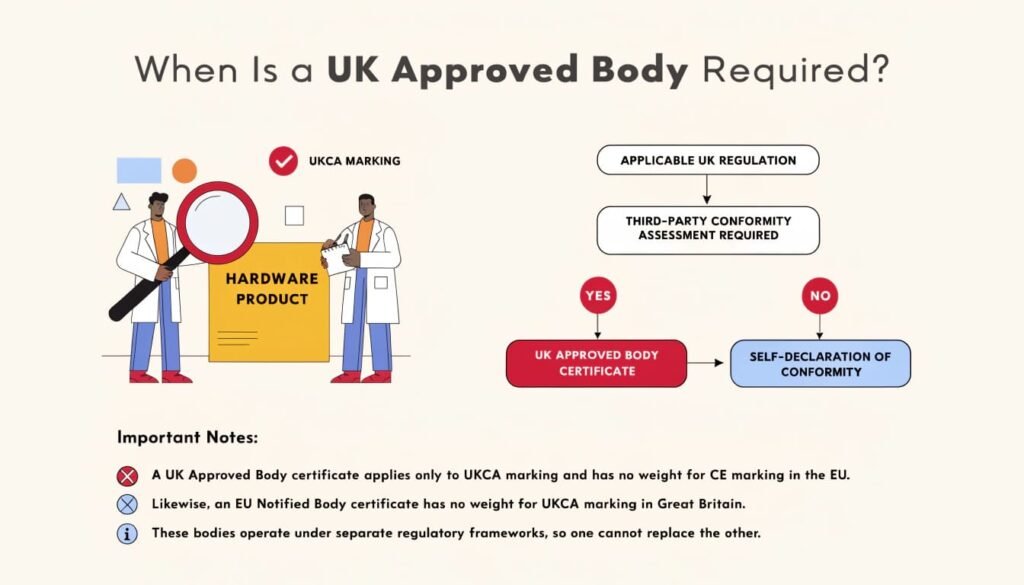
A UK Approved Body is required only when the applicable UK regulation requires third-party conformity assessment1 for that specific Hardware Product category. If the category allows self-declaration, you do not need a UK Approved Body.
A UK Approved Body certificate applies only to UKCA marking and has no weight for CE marking in the EU Likewise, an EU Notified Body certificate has no weight for UKCA marking in Great Britain. These bodies operate under separate regulatory frameworks2, so one cannot replace the other.
What Is CE Marking, and Which Markets Require It?
CE marking is the conformity marking required for regulated Hardware Products placed on the European Economic Area market. CE stands for Conformité Européenne in French. Unlike UKCA, CE marking is not limited to one territory. It is the mandatory conformity mark across the EU, the EEA, and Northern Ireland.
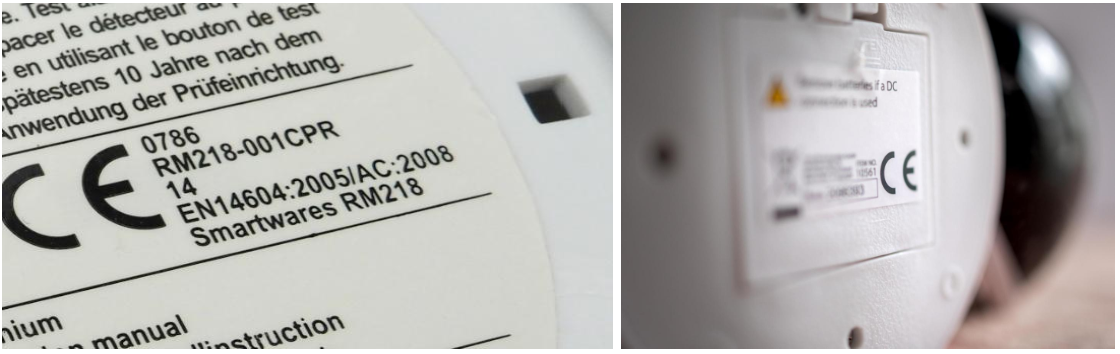
A government body does not issue the CE mark to the manufacturer. Instead, the manufacturer makes its own legal declaration that the Hardware Product meets all applicable EU directive requirements. The manufacturer supports that declaration with the required technical documentation and EU Declaration of Conformity.
Which EU Directives and Regulations Require CE Marking?
CE marking is the final conformity marking for the EU directives or regulations that apply to a specific Hardware Product. The most commonly applicable include:
- Low Voltage Directive
- Electromagnetic Compatibility Directive
- Machinery Directive
- PPE Regulation
- Toy Safety Directive
- Radio Equipment Directive
- Pressure Equipment Directive
A Hardware Product can fall under more than one directive. When it does, the manufacturer must meet the requirements of every applicable directive before legally affixing the CE mark. The manufacturer must also reference all applicable directives in the EU Declaration of Conformity. For higher-risk Hardware Product categories, an EU Notified Body must take part in the conformity assessment procedure, and its four-digit identification number must appear alongside the CE mark.
Since October 2024, UK legislation has confirmed the recognition of CE marking in Great Britain for 21 regulated product categories including electrical equipment, machinery, toys, personal protective equipment and radio equipment. This gives CE marking dual relevance it provides EU market access and remains accepted for many Hardware Product categories placed on the Great Britain market under current UK legislation.
UKCA vs CE Marking: What Are the Key Differences?
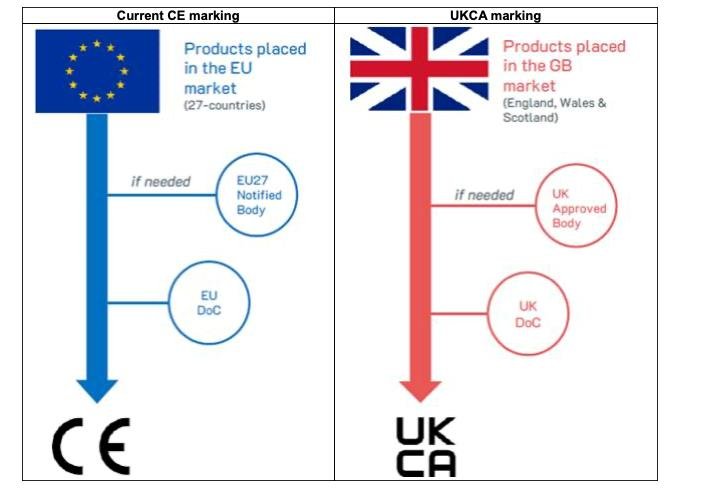
UKCA and CE Marking follow similar compliance principles, but manufacturers cannot treat them as interchangeable. That is where many Hardware Product manufacturers run into compliance problems. The two systems operate under different legal frameworks, use different standards and conformity assessment bodies, and apply to different markets.
is where the two systems diverge:
| UKCA Marking | CE Marking | |
|---|---|---|
| Regulatory framework | UK statutory instruments | EU directives and regulations |
| Market covered | Great Britain only | EU, EEA, and Northern Ireland |
| Standards | UK designated standards | EU harmonised standards |
| Third-party body | UK Approved Body | EU Notified Body |
| Declaration required | UK Declaration of Conformity | EU Declaration of Conformity |
| Recognition in Great Britain | Yes | Yes — for 21 product regulations |
| Northern Ireland | Not recognised | Required |
| EU market access | No | Yes |
The table gives you the basic framework. But what does this actually mean when you are developing and placing real Hardware Products on the market?
- A power tool falls under the Supply of Machinery (Safety) Regulations 2008 for UKCA and the Machinery Directive 2006/42/EC for CE.
- A children’s toy falls under the Toys (Safety) Regulations 2011 for UKCA and the Toy Safety Directive 2009/48/EC for CE.
- An electrical appliance falls under the Electrical Equipment (Safety) Regulations 2016 for UKCA and the Low Voltage Directive 2014/35/EU for CE.
A Hardware Product that meets one system does not automatically meet the other. This remains true even when the technical requirements appear almost identical. Having one conformity marking does not automatically satisfy the requirements of the other market.
Here are the practical differences Hardware Product manufacturers need to understand:
- Conformity assessment bodies: Some conformity assessment bodies hold both UK Approved Body and EU Notified Body designations. However, the assessments themselves remain separate. A certificate issued for one system does not automatically cover the other market.
- Declarations of Conformity: If you are placing a Hardware Product on both markets, you must complete both declarations separately. A UK Declaration of Conformity refers to UK statutory instruments, while an EU Declaration of Conformity refers to EU directives. These are legally separate documents.
- Regulatory divergence: According to the UK’s Office for Product Safety and Standards, differences between UK and EU standards are already developing in certain product areas and are expected to increase. This means a Hardware Product that fully meets CE requirements today may not meet UKCA requirements in the future, even if you have made no changes to the product itself.
Northern Ireland and When UKNI Marking Applies
The UKNI mark is a conformity marking specifically for Northern Ireland. This is because Northern Ireland follows EU product rules, so CE marking applies there rather than UKCA.
If a Hardware Product requires mandatory third-party conformity assessment and a UK Approved Body performs that assessment instead of an EU Notified Body, the product must carry both CE and UKNI markings.
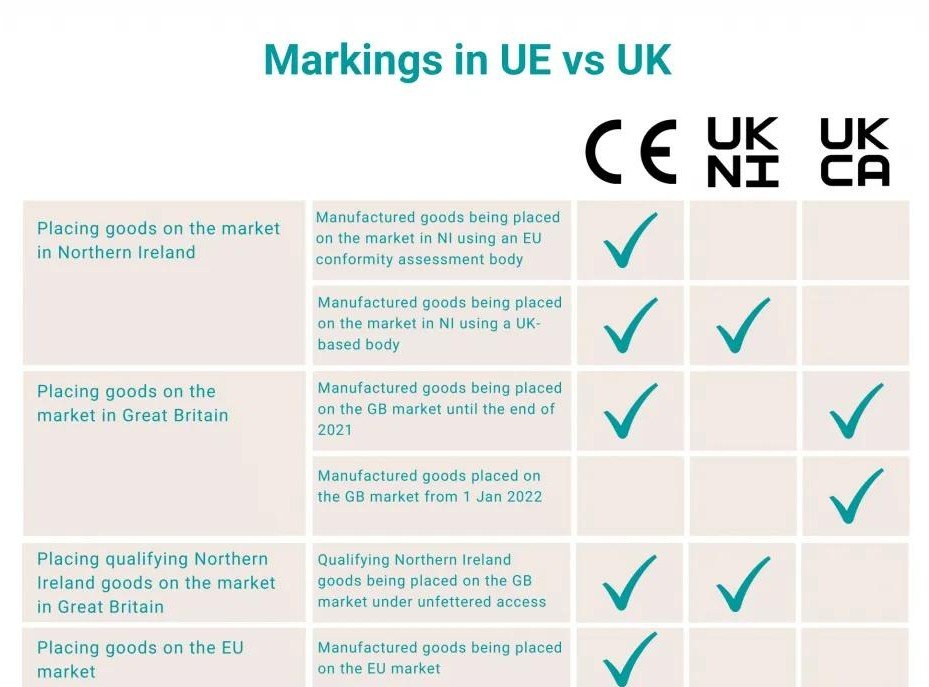
- CE + UKNI is required when a UK Approved Body carries out mandatory third-party conformity assessment for a Hardware Product placed on the Northern Ireland market.
- CE alone is sufficient when an EU Notified Body carries out the conformity assessment.
UKNI never stands alone It always appears alongside CE. This is why many businesses selling Hardware Products in both Northern Ireland and the EU choose an EU Notified Body from the beginning. One assessment can cover both territories without triggering the need for UKNI.
Does Your Product Need UKCA Marking, CE Marking, or Both?
The correct conformity marking for a Hardware Product depends on where you place the product on the market, and not where you manufacture it.
Placing Hardware Products only on the Great Britain market? CE marking is currently recognized for 21 regulated product categories in Great Britain under the October 2024 UK legislation. For those categories, UKCA marking is not compulsory. If your Hardware Product falls outside that recognition list, the applicable UK statutory instrument determines which conformity marking you need.
Placing Hardware Products only on the EU or EEA market? CE marking is mandatory. UKCA marking has no legal effect in the EU and does not satisfy EU product requirements, regardless of which UK conformity assessment steps you have already completed.
Placing Hardware Products on the Northern Ireland market? CE marking is required, while UKCA marking does not apply. If a UK Approved Body carries out mandatory third-party conformity assessment, the Hardware Product needs both CE and UKNI marking, as explained above.
Placing Products on Both the UK and EU Markets: What Does That Mean in Practice?
For many Hardware Product categories, valid CE marking can cover both markets at the same time. It satisfies EU product requirements and is recognised in Great Britain under current UK legislation.
However if both UKCA and CE compliance are specifically required, or if UK and EU product requirements diverge in the future, you may need separate conformity assessment procedures and technical documentation for each market.
That means dual-market Hardware Product compliance planning should start with one clear question: Does your product category fall within the 21 regulated categories where CE marking is currently recognised in Great Britain, or does it fall outside that list?
What If Mandatory Third-Party Assessment Is Required in Both Markets?
If your Hardware Product requires certification from both an EU Notified Body and a UK Approved Body, you must complete two independent conformity assessment procedures. Each assessment operates under its own regulatory framework, and there is no automatic crossover between them.
Businesses in this position need to plan both assessment routes from the beginning. They also need to prepare the correct technical documentation and Declaration of Conformity for each market separately.
Getting Your UKCA and CE Marking Right
UKCA and CE marking are not interchangeable. The correct marking for your Hardware Product depends on the product category, the regulations that apply to it, and the markets where you plan to place it.
Before placing any regulated Hardware Product on the Great Britain or EU market, first identify the legislation that applies to the product. Then confirm your destination markets and make sure you have the correct conformity assessment route and documentation fully in place.
If you are still developing your Hardware Product, Startup Molding can help you start in the right place. It helps hardware startups move from concept to production-ready products at the stage where getting UKCA and CE marking requirements right can make all the difference.
Frequently Asked Questions About UKCA and CE Marking
Is UKCA marking still required in 2025 and 2026? For most regulated Hardware Product categories placed on the Great Britain market CE marking is accepted under October 2024 UK legislation. UKCA marking remains required for Hardware Product categories outside that recognition list.
Can CE marking be used to place Hardware Products on the Great Britain market right now? Yes, for the 21 Hardware Product categories currently recognised under UK legislation, including electrical equipment, machinery, toys, personal protective equipment, and radio equipment. For categories outside that group, UKCA marking may still be required.
Can a Hardware Product legally carry both UKCA and CE marking at the same time? Yes provided the applicable compliance requirements for each regulatory framework have been independently satisfied. Many Hardware Products placed on both the EU and Great Britain markets already carry both conformity markings.
Does UKCA marking apply to Hardware Products placed on the Northern Ireland market? No. Northern Ireland follows EU product rules, and UKCA marking alone does not satisfy Northern Ireland Hardware Product requirements.
Is a UK Approved Body always required for UKCA compliance? No. Many Hardware Product categories permit self-declaration. A UK Approved Body is only required when the applicable UK regulation specifically mandates third party conformity assessment for that Hardware Product category.
-
"UKCA mark certification for the United Kingdom", https://www.dnv.us/services/industrial-product-assurance/ukca-mark-certification-for-the-united-kingdom-203306/. UK product safety regulations designate specific product categories that require third-party conformity assessment by a UK Approved Body, while other categories permit manufacturer self-declaration of conformity for UKCA marking. Evidence role: general_support; source type: government. Supports: UK regulations specify which product categories require third-party conformity assessment. Scope note: This provides the general regulatory structure but does not enumerate specific product categories or the criteria determining assessment requirements. ↩
-
"Conformity Assessment of Medical Devices – PMC – NIH", https://pmc.ncbi.nlm.nih.gov/articles/PMC12821529/. Following the UK’s withdrawal from the EU, UK Approved Bodies and EU Notified Bodies operate under distinct regulatory frameworks, with UK Approved Bodies designated under UK law for UKCA marking and EU Notified Bodies designated under EU law for CE marking, resulting in non-mutual recognition of certificates. Evidence role: mechanism; source type: government. Supports: UK and EU conformity assessment bodies operate under separate regulatory frameworks following Brexit. Scope note: This describes the post-Brexit regulatory structure but does not address any transitional arrangements or sector-specific exceptions that may exist. ↩