
The statement ‘no federal law requires every hardware product sold in the United states to carry a UL mark’ is correct but dangerously incomplete. Federal workplace regulations, state electrical codes, retailer requirements and insurance expectations combine to make recognized safety certification almost unavoidable for many electrical and electronic hardware products. Whether UL Certification applies to your hardware product and whether you actually need UL certification depends on what it is, where it is used and who has to buy, install or insure it.
That gap between ‘not universally required’ and ‘not required for your specific hardware product’ is exactly where most hardware startups and manufacturers really get into serious trouble.
What is UL Certification?
UL Certification is an independent, third-party product safety evaluation.It is not government approval, nor a quality rating and certainly not a manufacturer’s self-declaration. When a hardware product bears an authorized UL Certification Mark it tells the entire supply chain – retailers, buyers, inspectors, insurers and end-users that an independent organisation evaluated the product against established safety standards and confirmed that it met those standards.
UL was founded in 1894 by William Henry Merrill, a 25-year-old electrical engineer who had been hired to assess fire hazards at the 1893 Chicago World’s Fair. He presented his idea for an independent electrical testing laboratory to the Western Insurance Union and the Chicago Underwriters Association. Both organizations funded the project, thus creating what would later be known as Underwriters Laboratories, now operating as UL solutions. The name ‘Underwriters’ reflects that original connection to the insurance industry. Merrill’s initial mission was to assist insurers in determining whether the products and buildings they insured represented a fire and electrical risk. That mission remains the very heart of the message conveyed by a UL Certification Mark today.
Today, UL solutions – the commercial arm of the organisation – tests and certifies hardware products in over 110 countries. UL began life as a non-profit organisation, changed partially to a for-profit structure in 2012 and then became a publicly traded company in 2024. That change doesn’t affect the legal significance of a UL Certification Mark but does provide important background that most published discussions about UL don’t even mention.
What is the difference between a UL Test Report and the UL certification process?
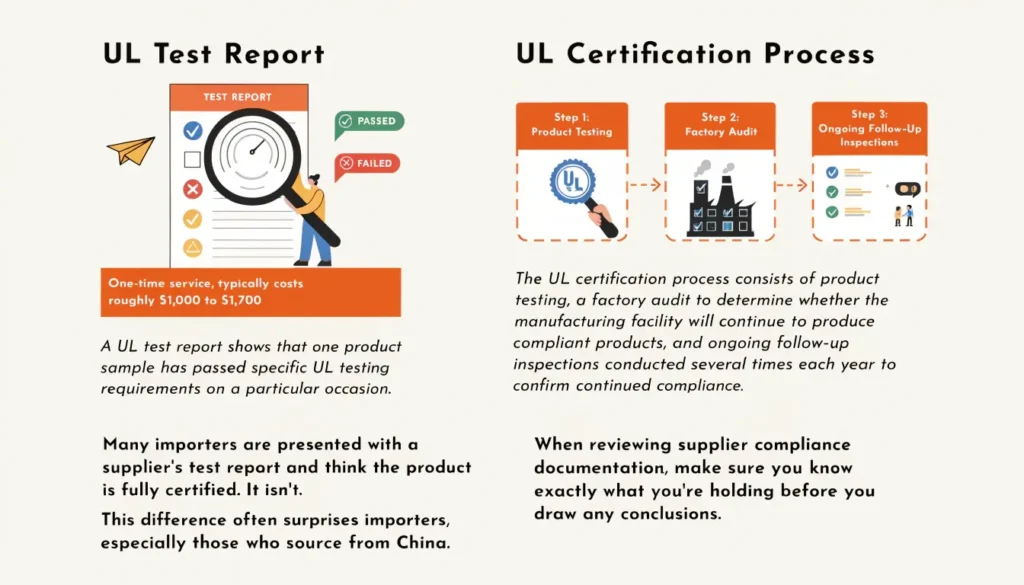
This difference often surprises importers more than almost anything else – especially those sourcing from China. A UL test report shows that one product sample has passed specific UL testing requirements on a particular occasion. It costs roughly $1,000 to $1,7001 and sets out what happened with that sample on that specific date. The UL certification process however is quite different. It consists of product testing, a factory audit to determine whether the manufacturing facility will continue to produce compliant products and ongoing follow-up inspections carried out several times each year2 to confirm continued compliance.
A test report shows that one sample has passed some tests. However, full certification will prove that both the product and its manufacturing process remain under ongoing, continuous surveillance. Many importers are presented with a supplier’s test report and think the product is fully certified. It isn’t. If you’re currently reviewing your supplier’s compliance documentation, make sure you know exactly what you’re holding before you draw any conclusions.
The Three UL Marks and what each one means
There isn’t really a ‘UL certification.’ Rather, there are three distinct marks – and understanding the differences between UL Listed, UL Recognized Component and UL Classified will determine what follows.
| UL Mark | What It Applies To | Scope of Evaluation |
|---|---|---|
| UL Listed | Finished, standalone products | Full independent testing against safety standards. Ongoing factory inspections are required. |
| UL Recognized Component | Parts inside a larger finished product | Component-level evaluation for use inside a certified end product. The finished product is not automatically certified. |
| UL Classified | Products evaluated for one specific safety property only | Testing against one characteristic such as fire resistance not a full evaluation of the product. |
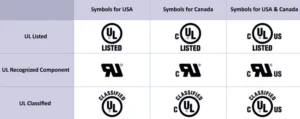
UL Listed is the mark consumers really know best – it appears on finished products such as power strips, household appliances, and smoke detectors. UL Recognized Component applies to components such as power supplies and circuit boards that feature in a finished product. Even if a manufacturer uses UL recognized components, they will still need a separate evaluation for the product. UL Classified most frequently appears on building materials and fire protection products evaluated against one specific safety attribute.
No product will bear these marks without UL authorization.In January 2026, Amazon and UL started a lawsuit in the U. S. District Court for the Western District of Washington against sellers who were marketing e-bike and e-scooter products carrying UL marks that UL had never actually authorized. A consent judgment was signed on July 7, 2026 which permanently stopped those defendants from importing, distributing or selling products with counterfeit or unauthorized UL marks. Using a UL mark without authorization is trademark fraud and is not a way of bypassing compliance regulations.
Why UL certification matters beyond the actual mark
Product safety isn’t just an engineering issue it’s also a requirement further down the supply chain. When your hardware product moves through the supply chain from the manufacturer to the importer, from the importer to the distributor, then from the distributor to the installer or end user every party in that whole chain needs a solid reason to believe that the product won’t cause a fire, an injury or a liability event. An independent third-party certification creates that trust right along the entire supply chain.
Now look at the commercial market. Major retailers such as Amazon, Walmart, Home Depot and Lowe’s regularly require evidence of safety certification before they will even list or stock an electrical or electronic hardware product. Even commercial and industrial buyers will sometimes say ‘NRTL certified’ right within their purchasing contracts. Insurance companies may refuse to insure a warehouse that holds products that haven’t been certified and if an un-certified hardware product is later linked to a fire or injury, the fact that it wasn’t certified will be the main focus of any lawsuit. Certification proves that you completed all necessary compliance procedures before anything went wrong.
Starting your compliance plan during the hardware product design stage, rather than waiting until your tooling is complete, isn’t a luxury. It’s one of the most cost-effective decisions you can make. If a hardware product fails UL testing because the PCB layout didn’t have the necessary creepage distances, the redesign costs several times more than creating the layout right in the first place. Early planning keeps you in control while making a late discovery leaves you with very few options.
When is UL certification required?
Federal workplace requirements (OSHA)
If your hardware product is electrical equipment made for use in a workplace then it has to be approved by an OSHA-recognized NRTL before you’re allowed to legally install it. OSHA’s general industry electrical safety standard under 29 CFR 1910.303(a) says that electrical equipment used in a workplace is ‘acceptable only if approved.’ Under 29 CFR 1910.399 ‘approved’ means a Nationally Recognized Testing Laboratory an NRTL has listed or labelled the product. The exception for custom-made equipment built for just one customer is very narrow and hardly ever applies to off-the-shelf hardware products.
The national Electrical Code
If you intend to install your hardware product in any permitted electrical installation residential, commercial, or industrial it needs a recognized listing mark before an inspector will accept the installation. Across the United states, states and local jurisdictions adopt and enforce their own electrical codes based on the national Electrical Code NFPA 70 although the edition and local requirements varies. When an electrical inspector turns up to approve a permitted installation, one of the first things they’ll check is whether your hardware product carries that mark. If it doesn’t, the inspector officially known as the Authority Having Jurisdiction (AHJ) might reject the installation and tell you to take out the equipment. This immediately puts the project on hold and starts an expensive and time-consuming field evaluation process.
Children’s products
If your hardware product is a children’s product then it has to be tested by a CPSC-accepted third-party laboratory before you’re allowed to sell it in the United states. Under the Consumer Product Safety Improvement Act, there are no exceptions to this mandatory third-party testing duty. For electrically operated toys and articles, the relevant testing standards often use UL standard numbers but that doesn’t necessarily mean you’ve got to have a UL Certification Mark every time.
Retailer and e-commerce requirements
If you plan on selling your hardware product through a major retailer or online marketplace, certification becomes necessary if that sales channel demands it as a condition for including or stocking your product. Amazon, for instance, needs test reports from an ISO/IEC 17025-accredited laboratory for lots of electronic hardware products. Its published policy mentions specific UL standards for particular product groups:
- Chargers and power adapters: UL 62368-1 or UL 60950-1
- Hoverboards and e-scooters: UL 2272, with batteries tested to UL 2054 or an equivalent standard
- Hair dryers: UL 859 or UL 1727
- Seasonal lighting: UL 588
- Portable power inverters: UL 458 or UL 2743
If you don’t provide all the necessary documentation, Amazon may put your product listing on hold. Other major retailers and commercial buyers probably has their own certification requirements always check the specific requirements of your intended sales channel before guessing what’s needed or not.
Insurance and Liability
If your hardware product is electric or electronic and is involved in a fire, injury or property damage claim later on, then the lack of a recognised certification becomes a major point in establishing liability. Some insurers consider product safety certification when evaluating your risk for certain electric or electronic products and the individual policy may contain very specific certification requirements. Whether an insurance claim is actually covered really depends on the terms of the policy and the whole situation surrounding the loss. The CPSC has a wide authority to pursue every company in the supply chain manufacturers, importers, distributors and private-label brands for selling hazardous or non-compliant products. A brand owner putting their name on a product takes on the manufacturer’s compliance responsibility, regardless of who actually made it.
UL certification isn’t essential for all hardware products universally.It may become necessary or very much expected due to existing workplace requirements, electrical codes, product-specific regulations, retailer policies or even customer specifications. Many times the requirement is for certification by an appropriately recognised NRTL instead of UL.
UL is not the only option: understanding the NRTL system
When a law or electrical code needs an NRTL certification, it won’t necessarily point to UL. Currently, OSHA recognises 22 NRTLs and each NRTL mark has equal legal standing. Because UL creates a lot of the safety standards that all NRTLs use for testing, many manufacturers assume they have to use UL. That assumption is incorrect. The standards are public and any OSHA-recognised NRTL can certify a hardware product to them.
Which Hardware Products need UL Certification – and which ones don’t?
Hardware products that really need recognized safety certification have one important thing in common: they present potential hazards related to electricity, fire, heat or mechanical failure. Common hardware product categories include:
- Household electrical appliances (toasters, microwaves, hair dryers, irons)
- Consumer electronics (laptop chargers, power banks, audio/video equipment)
- Lighting products (LED luminaires, fluorescent fixtures, holiday string lights)
- Power supplies, battery chargers and battery management systems
- Wiring devices, circuit breakers, panelboards, switchgear and industrial control panels
- HVAC equipment (furnaces, air conditioners, heat pumps)
- Fire protection products (smoke alarms, fire extinguishers, sprinkler components)
- Extension cords, power strips and surge protective devices
- Nonmetallic-sheathed cable and other permanent wiring products
But hardware products that generally don’t need UL certification are non-electrical consumer goods controlled by the FDA (food, drugs, medical devices) or the CPSC (furniture, toys that aren’t electrically operated, apparel). Also, even some low-voltage, battery-operated products that never connect to the main power supply might not be covered by the NEC or OSHA requirements. Nevertheless, retailer and insurance requirements will bring those products into the testing process too, so don’t ever assume you’re exempt just because of the voltage.
How do you decide whether your hardware product needs UL certification?
Before you start spending money on testing or think your hardware product doesn’t need it answer these questions yourself before you even begin manufacturing:
- Does your hardware product show electrical, fire, heat or mechanical hazards?
- Where exactly will your hardware product be fitted or used in residential, commercial or an industrial setting?
- Who’s your intended customer and what standards do they need for procurement or installation?
- Through which distribution channels will your hardware product be sold and what certification policies do they follow?
- Are you importing? Starting from 8th July 2026, importers have to file electronic certificates of compliance with U. S. Customs and Border Protection if they’re bringing in covered consumer products. Any documentation supporting your certification mark is subject to far greater scrutiny at the border.
- What does your hardware product liability insurer require and what are the coverage implications if there’s a claim involving an un-certified hardware product?
These questions will help you figure out if UL certification is relevant to your hardware product but won’t replace a review of the actual UL standards, local electrical codes, and market requirements that are specific to your product category. The key thing is to establish your hardware product type, its intended use, the installation environment and your target market’s requirements before deciding whether UL certification or another recognized NRTL certification is the best option.
Common UL certification misconceptions costing hardware product manufacturers money
Manufacturers and importers are susceptible to making avoidable errors in either direction due to a number of very common misconceptions.
UL is a government agency. It isn’t. UL solutions is a private, independent organization. OSHA is the federal government agency in this area and OSHA doesn’t even test products. It recognises private sector NRTLs (nationally recognized testing laboratories) and makes sure their marks appear on all workplace electrical equipment.
UL certification is the only legally acceptable option. It isn’t. When the law demands certification, it demands NRTL certification. All 22 OSHA recognized NRTLs issue marks with equal legal standing. No law gives UL priority over another recognized NRTL.
A test report and full certification are virtually identical things. They aren’t. A test report merely addresses one sample on one particular date. Full certification covers the product its manufacturing process, and ongoing production through continuous surveillance inspections.
UL certification applies worldwide. It doesn’t. UL certification is a North American framework. CE marking is equivalent for the European Union a completely different legal system with no mutual recognition between them. A UL marked hardware product isn’t certified for Europe and a CE-marked hardware product isn’t certified for the US market.
Every product needs a UL mark. It doesn’t. Non-electrical products are governed by completely separate regulatory frameworks. Applying a UL mark to any product without explicit authorization isn’t a compliance loophole it will lead to extremely serious legal and commercial repercussions, just like the 2026 Amazon and UL lawsuit made abundantly clear.
What to do next
If your answers to the questions above suggest that recognized safety certification is necessary, determine the relevant UL standard during the hardware product design phase work with a recognized testing laboratory before manufacturing commences and be certain to incorporate both the cost and timeline in your development plan right from the start. If your hardware product appears to fall outside an applicable program confirm that conclusion against the specific standards and regulatory requirements for your product category and intended market before making any assumptions either way.
If you’re at this very early stage right now, Startup Molding will assist hardware startups in progressing from concept to production-ready products through DFM consulting, prototype tooling, injection moulding and low-volume manufacturing the very stage where getting your hardware product right really matters most.
Frequently Asked Questions
Do I need UL certification for my hardware product?
This depends on your hardware product, its intended location of use and what your retailer, installer or insurer demands. There is no federal law requiring every hardware product to carry a UL mark – but OSHA workplace regulations, the national Electrical Code and retailer policies can make recognized safety certification practically unavoidable for a lot of electrical and electronic products.
What is the difference between UL listed and UL recognized component?
UL listed refers to finished, standalone hardware products that have undergone complete testing against relevant UL standards. UL recognized component refers to components fitted inside a bigger finished product – and a UL recognized component mark on a component won’t mean that the finished hardware product is UL certified.
Is a UL test report the same as full UL certification?
They aren’t the same thing. A UL test report will confirm that one sample did indeed pass UL testing requirements on that particular occasion. The UL certification process really goes further including product testing, a factory audit and ongoing follow-up inspections. Lots of importers get the two mixed up – and that confusion presents a real risk of non-compliance.
Is UL certification the only way to meet U. S. Safety requirements?
OSHA recognises 22 nationally recognised testing laboratories and each NRTL mark has the same legal standing. When certification is actually required by law then the requirement is for NRTL certification rather than UL. Any OSHA-recognised NRTL laboratory can be used to certify your hardware product against the relevant UL standards.
-
"How Much Does UL Certification Cost?", https://www.jjrlab.com/news/how-much-does-ul-certification-cost.html. UL testing costs vary significantly based on product complexity, test scope, and specific standards applied, with basic test reports for simpler products generally falling in the lower thousands of dollars. Evidence role: general_support; source type: other. Supports: typical cost ranges for basic UL product testing services. Scope note: Actual costs depend on numerous factors including product category, number of tests required, sample preparation, and whether additional engineering evaluation is needed. ↩
-
"NRTL Program Policies, Procedures, and Guidelines.", http://www.osha.gov/enforcement/directives/cpl-01-00-003. UL’s Follow-Up Service program typically involves periodic unannounced factory inspections to verify ongoing compliance with certification requirements, though exact frequency may vary by product category and certification type. Evidence role: general_support; source type: institution. Supports: the typical frequency of follow-up inspections in UL’s certification maintenance program. Scope note: Inspection frequency can vary based on product risk level, manufacturing history, and specific certification program requirements. ↩