
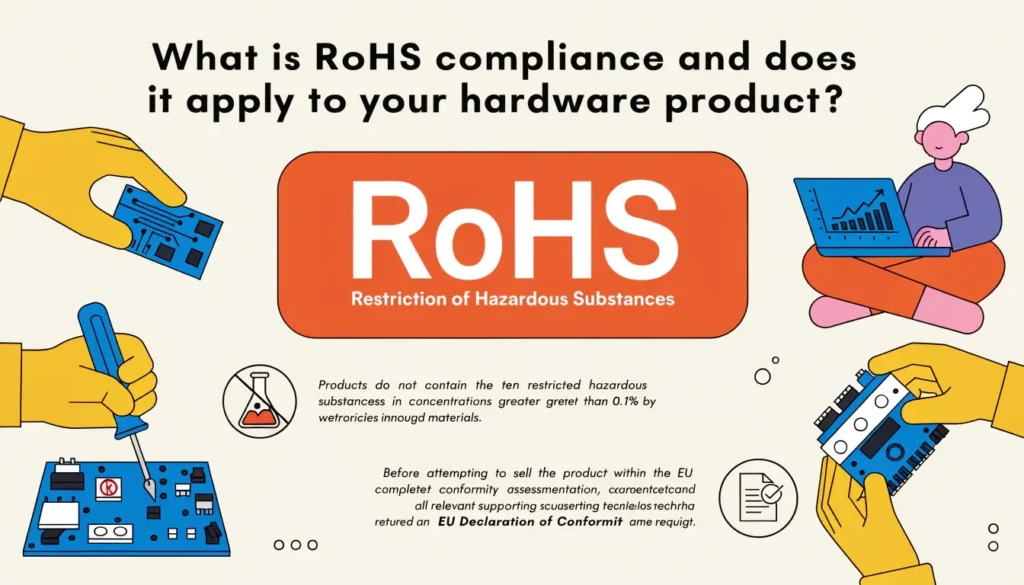
RoHS compliance – short for Restriction of Hazardous Substances – is a legal requirement limiting specified hazardous materials in electric and electronic equipment sold within the European Union’s market. It is controlled by Directive 2011/65/EU and its amendments. If your product includes any of the ten RoHS restricted substances and no applicable exemption covers that particular use – you can’t lawfully put it onto the EU market.
Lots of hardware start-ups deal with RoHS as a matter to be handled after the product is made. Others think their contract manufacturer or component supplier has fully taken care of it already. Some believe it only pertains to big electronics brands. None of these assumptions stand up against EU law and relying on them will put your product, your market access and your business at very real risk.
What is RoHS compliance and does it apply to your hardware product?
RoHS compliance really means that your electric or electronic product doesn’t have the ten restricted hazardous substances in concentrations greater than what’s allowed – and that you can show this quite clearly with a completed conformity assessment, all relevant supporting technical documentation and an EU Declaration of Conformity before you even attempt to sell the product within the EU market.
Lead, mercury, cadmium and many other hazardous materials were pretty standard in electronics manufacturing over several decades. Lead was basically the primary material used in electronic solder1. Mercury was employed in switches, thermostats and display backlights. Cadmium turned up in metal coatings, batteries and pigments. When consumer electronics started to be mass-market products, the quantity of discarded equipment really exploded – the hazardous substances within them seeped into the soil, contaminated groundwater and built up in ecosystems2. The EU reacted by restricting these substances right at the manufacturing level – all to safeguard human health and the environment.
EU RoHS is also not solely a European problem. RoHS-style requirements are active in China, South Korea, India, the UAE and in certain US states including California. Your material choices during product development actually affect compliance across lots of markets simultaneously – which makes an early understanding of RoHS compliance requirements essential – even if the EU isn’t your sole target.
Does RoHS Apply to Your Hardware Product?
The RoHS Directive has a wide scope – but will it actually apply to your particular hardware product? any applicable exclusions and whether a relevant exemption applies.

The categories of electrical and electronic products that are usually covered include:
- Large and small household appliances
- IT and telecommunications equipment
- Consumer electronics – TVs, audio equipment, cameras
- Lighting equipment including LED products
- Electrical and electronic tools
- Toys, leisure and sports equipment containing electronic components
- Medical devices
- Monitoring and control instruments, including industrial equipment
- Automatic dispensers
However, having an electronic component in a product does not necessarily mean RoHS applies to it. The product’s overall purpose and intended use is what determines whether it falls under the directive. Products explicitly excluded from the directive are large-scale fixed industrial installations, non-road mobile machinery that is exclusively available for professional use, military and defence equipment and equipment that has been designed for use in space. It’s worth noting there is a difference between an exclusion and an exemption. An exclusion signifies the RoHS Directive won’t be applied to your product at all – you have no RoHS responsibilities. An exemption, however, means the directive does apply but for one particular substance in one specific application you are allowed under certain conditions to exceed the standard limit. Treating one as the other is a compliance mistake which may prove very costly to rectify.
What substances is RoHS restricting and what are the limits?
If RoHS applies to your product, the directive restricts ten identified substances. Each one has a maximum concentration limit – meaning the quantity of that substance allowed by weight within any single homogeneous material in your product. A homogeneous material is any individual material that can’t be further divided through physical means – a solder joint, wire insulation, a metal plating or a plastic casing, each evaluated separately.
| Substance | Max. Concentration (by weight in homogeneous material) |
|---|---|
| Lead (Pb) | 0.1% (1,000 ppm) |
| Mercury (Hg) | 0.1% (1,000 ppm) |
| Hexavalent chromium (Cr VI) | 0.1% (1,000 ppm) |
| Polybrominated biphenyls (PBB) | 0.1% (1,000 ppm) |
| Polybrominated diphenyl ethers (PBDE) | 0.1% (1,000 ppm) |
| Bis(2-ethylhexyl) phthalate (DEHP) | 0.1% (1,000 ppm) |
| Butyl benzyl phthalate (BBP) | 0.1% (1,000 ppm) |
| Dibutyl phthalate (DBP) | 0.1% (1,000 ppm) |
| Diisobutyl phthalate (DIBP) | 0.1% (1,000 ppm) |
| Cadmium (Cd) | 0.01% (100 ppm) — ten times stricter than all others |
Directive 2011/65/EU – often referred to as RoHS 2 – originally listed the first six restricted substances. The four phthalates were later added by Directive 2015/863/EU, also known as RoHS 3, and these became enforceable from 22 July 2019 for virtually all product categories and from 22 July 2021 for medical devices and monitoring and control instruments. Cadmium carries a maximum concentration value of 0.01% (100 ppm) – in comparison to 0.1% for all the other restricted substances.
How the Homogeneous Material Rule Functions in RoHS
RoHS won’t consider your product as a single item and evaluate the entire quantity of a restricted substance across all components. Instead, it checks each and every material individually. So if even a very small part – say a solder joint – has lead over the 0.1% limit, that part will fail. You can’t then use all the lead-free materials elsewhere in the device to make up for it.
The results of JACOP 2025 – a coordinated market surveillance campaign that tested 173 electronic devices in 13 European countries, published by the European Commission in June 2026 – showed that 91 of these products, 53%, failed. Lead and cadmium were found most often in solder points, with 82 samples failing there. Phthalates were found in the soft PVC insulation and sleeves of USB cables, power cords and plugs, with 51 samples failing. Have you mapped all materials going into your product to this extent? The honest answer is probably no for almost all hardware startups at an early stage in their development – which is precisely why this needs to be done before making decisions about components and suppliers is too late.
RoHS Exemptions that Startups need to know
Exemptions exist for certain applications where no practical alternative to the restricted substance is currently available. They’re detailed in Annexes III and IV of the RoHS Directive. From 1 January 2026 the job of assessing exemption applications moved from the European Commission to the European Chemicals Agency (ECHA) under Directive (EU) 2025/2456. If your design really depends on an exemption be sure to confirm that it’s still valid and keep a close eye on it while your product is on the market. Exemptions have been modified and let lapse without prior warning more than once.
How does a hardware start-up show RoHS compliance?
A hardware start-up will demonstrate RoHS compliance by examining its products’ materials against the ten restricted substance thresholds, creating a technical documentation file supporting this evaluation and issuing an EU Declaration of Conformity prior to placing the hardware product on the EU market.
Showing RoHS compliance is the manufacturer’s obligation and cannot be entirely delegated to a supplier or contract manufacturer. As the manufacturer, you bear primary legal responsibility for ensuring that your electrical or electronic product fulfills the applicable RoHS specifications The conformity assessment necessary does not involve an outside organization approved by the government you perform it yourself. However, it has to be very thorough and completely recorded.
Supplier documentation forms the principal input to that assessment. The most valuable evidence forms to attain RoHS compliance comprise:
- Full material disclosures (FMD) detailed supplier documents showing the concentration of substances at the level of the homogeneous material; much more useful than simple declarations since the information remains valid even if new substances are added to the restricted list afterwards
- Supplier material declarations signed by an authorized individual at the supplier, stating the maximum possible concentration of each restricted substance in each homogeneous material
- Certificates of Compliance (CoC) formal supplier statements affirming that their components satisfy the RoHS criteria
- Laboratory test reports measured concentrations derived from RoHS testing carried out by accredited laboratories, utilised if documentation is weak or a supplier hasn’t been verified
A supplier’s statement simply saying there’s been no intentional use of a restricted substance won’t be enough to satisfy the documentation needed to be compliant with RoHS under EN IEC 63000:2018. Are you aware of what your suppliers are really declaring and have you confirmed that these declarations are reliable? Gaps in the chain of evidence are the exact places where your compliance problems come from.
RoHS testing, documentation and Declaration of Conformity
If the documentation is inadequate, laboratory testing will back up the assessment. XRF screening offers a fast, non-destructive examination for heavy metals. Wet chemical analysis by ICP or GC-MS gives you accurate, quantified results whenever XRF results are inconclusive particularly for solder joints, cable assemblies, surface coatings and platings supplied by new or unverified suppliers.
The harmonized standard EN IEC 63000:2018 determines how all this evidence gets structured right into a technical documentation file. It replaced EN 50581:2012 which had been withdrawn from the Official Journal on 18 November 2021. Any declaration of conformity based on EN 50581 really needs to be updated to the latest standard.
After completing the evaluation, the manufacturer compiles an EU Declaration of Conformity – a document whereby you claim that your hardware product really does meet the relevant RoHS requirements.
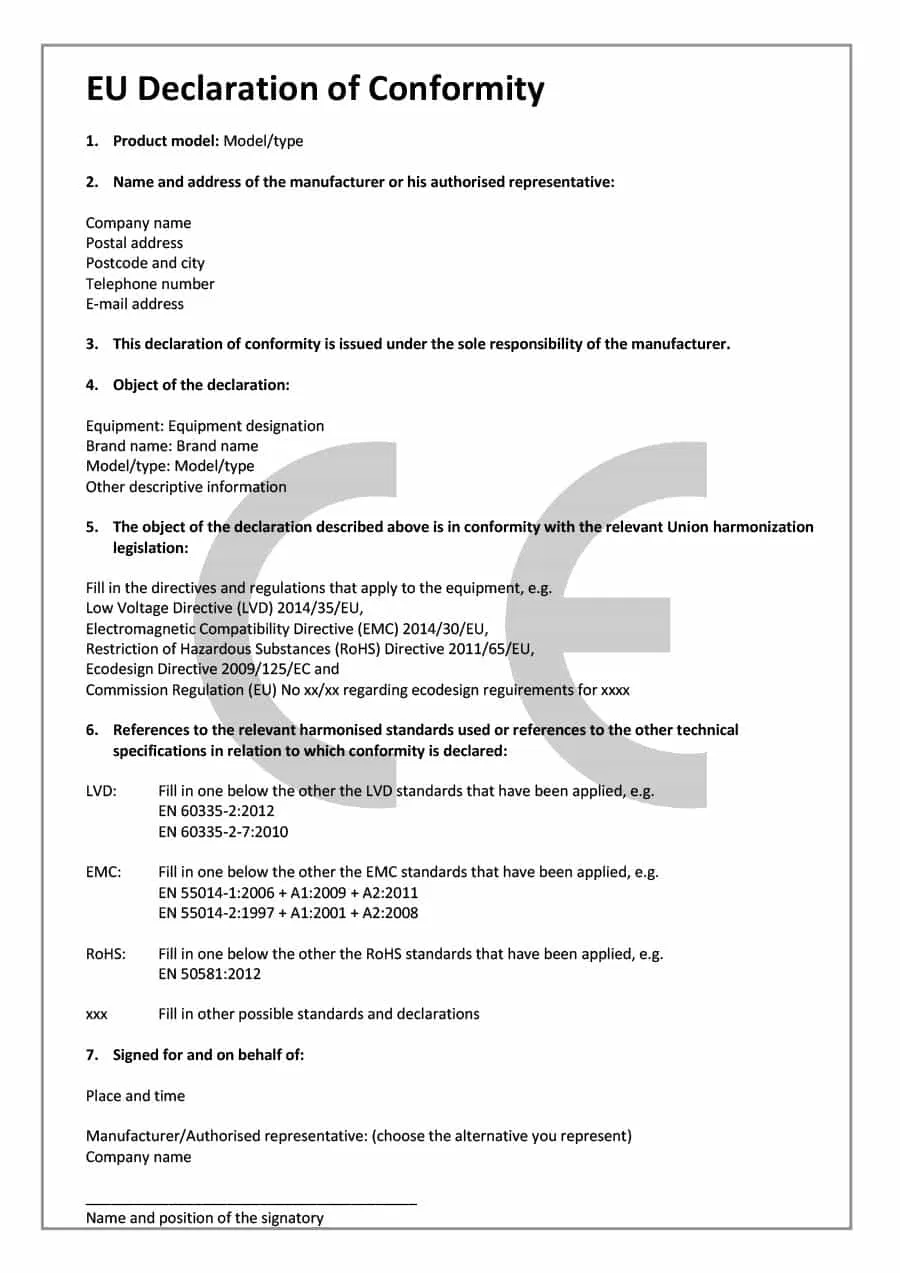
You may then apply for a CE mark after considering other relevant EU legislation there is no separate RoHS certification mark or label to purchase.
How Supplier Substitution Can Affect Your RoHS Compliance
One of the most frequent causes of non-compliance in hardware products sold on the EU market is a supplier secretly substituting a component because of supply pressure without informing the manufacturer. That change will bring in a restricted substance over the allowed limit into a product that was compliant.
Maintaining RoHS compliance needs agreements along your supply chain that require your suppliers to tell you about every component, material, or process change and each substitution needs to be checked against your compliance evidence to make sure it won’t affect your hardware product’s RoHS status.
How does RoHS fit into the broader EU compliance picture?
RoHS fits into the wider EU compliance picture through CE marking. When you’ve completed your RoHS compliance, that compliance feeds right into the CE marking process – it’s one of the requirements that have to be met before the CE mark can be applied.
RoHS compliance alone doesn’t mean your product is ready for the EU market. Since several EU directives may apply to the same product all at once.
Depending on the type of product, you might also need to meet the low Voltage Directive for electrical safety, the EMC Directive for electromagnetic compatibility, the Radio Equipment Directive for wireless products or the Machinery Regulation for powered equipment. Each relevant requirement has to be dealt with before CE marking can be properly applied.
Who is responsible for RoHS compliance throughout your supply chain?
Other companies in your supply chain too have their own legal obligations under RoHS. Importers bringing electrical and electronic products into the EU are required to review the manufacturer’s documentation and confirm the marking accepting a CE mark from a foreign supplier without looking at the compliance evidence isn’t enough. Distributors need to confirm that CE marking and documentation are there before putting those products onto the market. If an importer or distributor puts a hardware product under their own name, or modifies it in a way that does affect compliance, then they take on the manufacturer’s responsibilities. New start-ups located outside the EU could have to set up an appointed representative a company or person set up within the EU who works on your behalf for compliance reasons when there’s no existing EU importer fulfilling that duty.
RoHS restricts specific hazardous materials in electrical and electronic equipment. WEEE (the Waste Electrical and Electronic Equipment Directive) covers the collection, treatment and environmentally responsible disposal of waste electrical and electronic equipment. Both may be relevant to your hardware product via slightly different compliance procedures. RoHS and REACH are frequently talked about together because both impact substances in electronic products although they operate under different legislative systems.
Why RoHS compliance matters for start-ups
RoHS compliance really matters for start-ups since it is a legal market access requirement – not something that you may address after the hardware product is already built and ready to ship.
The reason It catches start-ups off guard is because of timing. Every material and component decision made during hardware product design determines whether your hardware product will comply. When you find out there is a problem with a restricted substance after a production run, it will mean replacing components, changing suppliers, performing tests, rebuilding your documentation and having a delayed market entry – all at a time when a start-up’s financial tolerance for unexpected costs is very low.
The European Commission’s Safety Gate 2025 report recorded 4,671 alerts for dangerous non-food products – including cosmetics, toys and electrical appliances – with 5,794 follow-up enforcement actions across Europe.
In Q1 2025, 60 products were recalled because of RoHS non-compliance, including LED light strips, headphones, wireless chargers and electronic scales. In Q3 2025, 30 products lost their EU market access with one showing lead in solder at 78.4% by weight against a maximum of 0.1% allowed. Enforcement outcomes include product withdrawal, a mandatory recall at the company’s expense and fines and corrective measures that varies depending on the member state. So achieving RoHS compliance is far easier and less expensive if you deal with it during your hardware product design, component sourcing and supplier qualification. When you make your material choices, select your PCB surface finishes or review a bill of materials with a manufacturing partner, all of these decisions directly affect your hardware product’s compliance status. Finding a restricted-substance issue at the prototype stage costs you a fraction of what it costs after production.
What your start-up should do to comply with RoHS
- Confirm if RoHS actually applies to your hardware product under the terms of directive 2011/65/EU
- Find out about the ten RoHS restricted substances and their limits; be sure that any exemption you depend on is valid
- Review your materials and components during development before making your design and supplier decisions
- Get material disclosures and signed compliance declarations from your suppliers
- Tell your suppliers that they have to inform you contractually of any component, material or process change
- Finish the conformity assessment following EN IEC 63000:2018, prepare all your technical documentation and then issue the EU Declaration of Conformity before placing the hardware product on the market
Start your RoHS compliance during your hardware product development
If your Hardware Product falls under the RoHS Directive, understand that RoHS compliance is not something you buy, and it is not just a sticker. It means making sure your electrical or electronic Hardware Product covered by the Directive really meets all the EU’s requirements and is fully RoHS compliant before you place it on the market.
If you are at the early stages of developing your hardware product, StartupMolding helps hardware startups move from concept to production-ready products through DFM consulting, prototype tooling, injection moulding and low-volume manufacturing the exact stage where addressing your RoHS compliance requirements early makes all the difference.
Frequently Asked Questions
Is RoHS compliance really necessary for all electronic products sold in the EU?
Not for every product. Certain ones come under specific exclusions – like military kit or very large industrial plants – and aren’t included.
What’s the difference between RoHS compliance and RoHS certification?
There is no actual RoHS certification to buy. You show you’re compliant through a conformity assessment, your technical documentation and an EU declaration of conformity.
How are RoHS restricted substance limits applied to electrical and electronic equipment?
Materials only. RoHS examines each homogeneous material on its own – one failing material will render the whole product non-compliant.
How do RoHS exemptions work and can they expire?
Yes. Exemptions have a validity period and have been both changed and lapsed pretty quietly. Don’t ever assume that an exemption previously valid is still valid today.
Does achieving RoHS compliance mean your product is ready for the EU market?
Not on its own. All other relevant directives also has to be met before CE marking can be applied.
-
"RoHS Ten Years Later: The Transition to Lead-Free …", https://www.indium.com/blog/rohs-ten-years-later-the-transition-to-lead-free-electronics-assembly/. Lead-based solders, typically tin-lead alloys (e.g., 63/37 Sn/Pb), were the industry standard for electronics assembly due to their favorable melting points and wetting properties until environmental regulations began restricting lead use in the early 2000s. Evidence role: historical_context; source type: encyclopedia. Supports: Lead-tin alloys were the predominant solder material in electronics manufacturing prior to RoHS implementation. Scope note: This addresses the historical use but may not quantify ‘primary’ in exact market share terms. ↩
-
"Health consequences of exposure to e-waste – PMC – NIH", https://pmc.ncbi.nlm.nih.gov/articles/PMC8674120/. International environmental assessments have documented that heavy metals from improperly disposed electronics can migrate into soil and groundwater through leaching processes, with demonstrated bioaccumulation in local ecosystems near e-waste disposal sites. Evidence role: mechanism; source type: institution. Supports: Hazardous substances from electronic waste can leach into soil and water systems, posing environmental and health risks. Scope note: This supports the contamination mechanism generally but may not specifically enumerate all pathways mentioned for each substance. ↩