
Home / Injection Mold Cost Estimator
BUDGETARY TOOLING ESTIMATE
Injection Mold Cost Estimator
Build an early tooling budget from part dimensions, annual demand, resin, mold steel and mold-action complexity. The estimate is directional; a formal quotation still requires CAD and a DFM review.
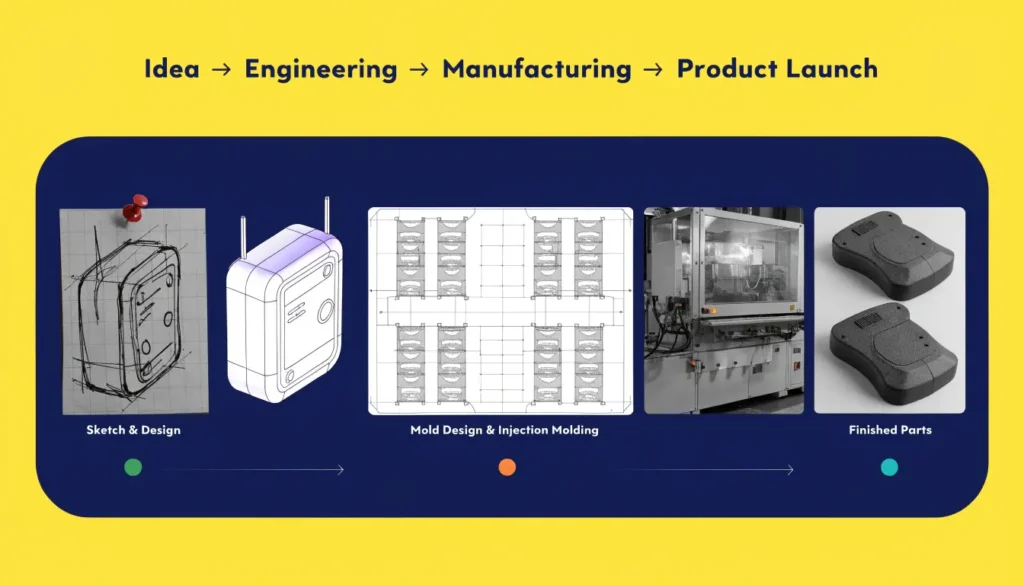
A practical budget before formal engineering
The estimator is intended for hardware startups and product teams comparing tooling scenarios before committing to detailed mold design. It converts inch inputs to millimeters, recommends a preliminary cavity approach, and shows a price range instead of a false single-number quote.
Budget the tooling stage
Compare a realistic range for small, medium, large or special molds before procurement planning.
See what drives cost
Part envelope, cavity count, steel, resin and side actions are reflected in the result.
Move to an engineer review
Submit the estimate details, then email the current STEP or STP file for DFM and quotation.
Calculate a Budgetary Mold Estimate
Enter the product envelope and the best available tooling assumptions. Required dimensions must be greater than zero and remain within the validation limits. Inch values are converted to millimeters before mold-base sizing.
Budgetary Estimate: This calculator is non-binding and is not a formal quotation. Final mold size, cost, cavities, steel and lead time require the 3D CAD file and DFM assessment.
How This Mold Cost Estimate Works
Dimensions are normalized to millimeters. The estimator lays out one, two or four preliminary cavities, adds a safe mold-base allowance, and rounds the result toward practical standard mold-base sizes. It then applies transparent budget factors for steel, mold actions, cavity count and resin demands.
What Affects Injection Mold Cost
Tooling cost changes with mold-base size, core and cavity steel, the number of cavities, sliders or lifters, cooling complexity, ejection, runner choice, expected life, inspection requirements and the finish required on the molded surface. A compact part can still need an expensive tool when its geometry creates difficult actions or tolerance risks.
Why Part Dimensions Are Not Enough for a Final Quote
Length, width and height describe only the product envelope. They do not reveal draft, shutoffs, wall thickness, ribs, bosses, undercuts, internal threads, parting-line requirements, tolerances, gate constraints or cosmetic zones. These details determine the real tooling architecture and must be reviewed in the 3D model.
How Annual Volume Affects Cavities and Mold Steel
Lower annual demand often favors a one-cavity tool because it limits upfront cost. Higher demand can justify two or four cavities to improve output per cycle, but the larger mold base, additional inserts, runner balance and process-control requirements increase tooling cost. Expected cycles also influence steel grade and heat-treatment decisions.
Why a STEP File and DFM Review Are Still Required
A current STEP or STP model allows an engineer to check the parting direction, draft, mold actions, gate and ejection strategy, expected shrinkage, cooling space and likely mold-base layout. The DFM review is what turns a budgetary range into a controlled quotation.
Email Your CAD File
For an engineer-reviewed quotation, please email your STEP, STP, X_T, SLDPRT, ZIP or PDF files to jerry@ckmold.com. Include your company or project name so the files can be matched with the estimate submission. You must attach the files yourself in the email client; this website does not upload or store them.
Frequently Asked Questions
Is this a formal injection mold quotation?
No. It is a non-binding budget range created from limited inputs. A formal quotation requires the current 3D CAD file, DFM review and confirmation of scope, steel, cavities, quality requirements and timing.
How accurate is the estimated tooling cost?
It is suitable for early planning and option comparison, not purchase approval. Accuracy improves when the selected resin, annual volume, steel and mold complexity reflect the real project.
Why can two similarly sized parts have different mold costs?
Undercuts, internal threads, tight tolerances, deep ribs, cosmetic surfaces, hot runners, inserts, cooling limits and inspection requirements can change mold architecture even when the outer dimensions are similar.
Which CAD file format should I email?
STEP or STP is preferred. X_T, native SLDPRT, a ZIP package or a supporting PDF drawing may also help. Include the company or project name used in the estimate form.
Can you also quote injection-molded production parts?
Yes. After reviewing the model and expected quantities, Startup Molding can quote tooling, sampling and molded-part production under a confirmed project scope.
What happens after I send my STEP file?
An engineer checks manufacturability, likely mold actions, cavity strategy, material risks and the probable tool layout. Clarifications are requested before a formal mold and molding quotation is issued.
Related Resources
Reviewed by Jerry Zou · Last updated August 28, 2026
Technical recommendations for a live project depend on the submitted revision, exact material grade, quality requirements, quantity, and agreed scope.
Ready to turn the estimate into an engineering review?
Send the current CAD revision and project requirements so mold layout, tooling scope, T1 timing and production assumptions can be confirmed.