
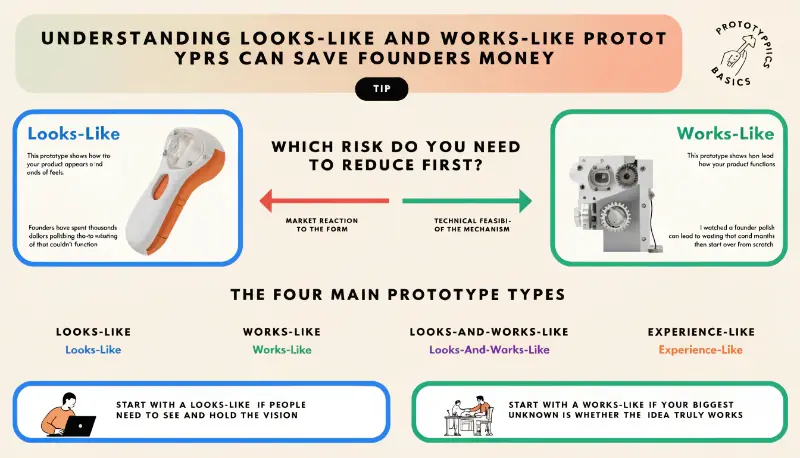
You have a product idea. Maybe even a rough prototype. But now you’re stuck. Do you spend money making it look beautiful, or making it actually work? Choose wrong, and you waste thousands of dollars and months of time.1 I’ve watched founders polish a design that couldn’t function, then start over from zero.
Looks-like prototypes show how a product appears and feels. Works-like prototypes show how it functions.2 For founders, the choice comes down to one question: which risk do you need to reduce first? Is it market reaction to the form, or technical feasibility of the mechanism? Start with looks-like when people need to see and hold the vision. Start with works-like when your biggest unknown is whether the idea truly works.
Understanding these two prototype types will save you real money. In this article, I’ll break down the four main prototype types, explain what makes a works-like prototype special, and show you exactly when to use each one. Let’s dive in.
What are the 4 types of prototypes?
Many founders think a prototype is just one thing. So they build one version, spend a fortune, and then realize it can’t answer their real questions. That mistake happens because they never learned that different prototypes serve different goals. The wrong type wastes both time and cash.
The four main types of prototypes are: looks-like prototypes (focus on appearance and feel), works-like prototypes (focus on function and performance), proof-of-concept prototypes (test one specific idea), and combined prototypes (merge looks and function together). Each type answers a different question during product development. Founders should match the prototype type to the biggest risk they need to reduce at their current stage.
Let me explain each type in simple terms. A proof-of-concept prototype is the roughest version. It tests just one idea. For example, will this tiny motor spin fast enough? It doesn’t care about looks or full function. It answers a single yes-or-no question.
A looks-like prototype focuses on size, shape, finish, and user experience. It may not work at all. But it helps people react to the design and feel.
A works-like prototype proves the core function. It can look ugly. But it shows the idea works under real conditions.
A combined prototype brings both together. This usually comes later, after you’ve reduced the big unknowns.
Here’s a quick comparison:
| Prototype Type | Main Goal | Looks Good? | Works? | Best Stage |
|---|---|---|---|---|
| Proof-of-Concept | Test one idea | No | Partially | Very early |
| Looks-Like | Show design & feel | Yes | No | Early |
| Works-Like | Prove function | No | Yes | Mid |
| Combined | Validate both | Yes | Yes | Later |
Picking the right type at the right time keeps your budget under control. Never build a polished combined prototype before you know the idea works.
What is a works-like prototype?
You built something beautiful. Investors loved the photos. Then you plugged it in, and it failed. The sensors were wrong. The battery died in an hour. Now you’re panicking, because the pretty shell hides a broken machine. This is the trap founders fall into when they skip works-like testing.
A works-like prototype is built to prove the core function or technical concept. It can look rough or unfinished. But it answers the key question: does the idea actually work under real conditions? Works-like prototypes replicate the functional mechanisms, electronics, software, or moving parts of your product. They help you find technical problems early, before you spend money on tooling or final design.
Think about a smart water bottle. The works-like prototype tests the sensor readings, the battery life, and the app connectivity. It doesn’t matter if it looks like a lab experiment with wires everywhere. What matters is that the technology works.
Why works-like prototypes matter
Works-like prototypes reduce your biggest engineering risks. They show if your mechanical parts hold up. They reveal if your electronics overheat. They tell you if your software talks to your hardware. These are the problems that kill hardware startups.
I once worked with a founder building a kitchen gadget. His looks-like model was gorgeous. But when we built the works-like version, we found the motor was too weak. Fixing it early saved him from ordering an expensive mold that would not fit the stronger motor.
What works-like prototypes often use
These prototypes often use off-the-shelf parts, 3D-printed brackets, breadboards, and development boards. The goal is speed, not beauty. Here’s a simple guide:
| Component | Works-Like Version | Final Version |
|---|---|---|
| Housing | 3D-printed or taped | Injection-molded |
| Electronics | Dev board | Custom PCB |
| Power | External battery pack | Integrated battery |
| Buttons | Loose switches | Molded buttons |
Use a works-like prototype to validate engineering risk. This helps you avoid overspending on polished design before your product is technically viable.
What is the difference between a working model and a prototype?
Founders often use "working model" and "prototype" as if they mean the same thing. So they order the wrong deliverable from a supplier. The supplier builds a display piece when the founder needed a functional test unit. Now money is gone, and the real question is still unanswered. Words matter here.
A working model is a prototype that actually functions. A prototype is the broader term. It includes non-working models built only to show appearance. So all working models are prototypes, but not all prototypes work. A "working model" is basically another name for a works-like prototype. When you talk to your manufacturer, always clarify whether you need something that just looks right or something that must actually run.
Let me make this crystal clear. The word "prototype" is like the word "vehicle." A car, a truck, and a bike are all vehicles. In the same way, looks-like models, works-like models, and proof-of-concept units are all prototypes.
A "working model" is one specific kind. It functions. It moves, lights up, or responds. It is your works-like prototype under a different name.
Why this confusion costs money
When you hire a prototype shop, they need to know your exact goal. If you say "I need a prototype," they might guess. Some shops assume you want a pretty display piece. Others assume you want a functional unit. The price difference is huge.
Here’s how the terms map out:
| Term You Might Hear | What It Usually Means | What It Costs |
|---|---|---|
| Prototype | Any early version | Varies widely |
| Looks-like model | Appearance only | Lower |
| Working model | Functional unit | Higher |
| Works-like prototype | Same as working model | Higher |
My simple advice
Always describe the job, not just the word. Say something like: "I need a unit that proves the motor and battery work, but the outside can look rough." Or say: "I need a model that looks like the final product for an investor photo, but it doesn’t need to function." Clear words prevent expensive mistakes.
What are the five types of prototypes?
You now know the four main types. But sometimes you’ll hear people talk about five. This adds confusion, because different sources count them differently. Founders end up unsure which framework to follow. Without a clear map, you can’t plan your prototype budget or timeline properly.
The five types of prototypes are: proof-of-concept (test one idea), looks-like (show design and feel), works-like (prove function), combined looks-like and works-like (validate both together), and pre-production prototype (test final materials and manufacturing methods). This five-type view adds the pre-production stage, which prepares your product for real mass production. Each type moves your product one step closer to launch and reduces a different type of risk.
The extra type in this list is the pre-production prototype. This one is important, and many founders forget it. After you have a combined prototype that looks and works right, you still need to test it with real production materials and methods.
Why the pre-production prototype matters
A combined prototype might use 3D-printed parts. But your final product will use injection-molded parts. These behave differently. The mold might create thin spots, warping, or weak seams. The pre-production prototype catches these issues before you commit to full production.
This is where EVT, DVT, and PVT stages come in. Here’s how the five prototype types connect to real production stages:
| Prototype Type | Purpose | Production Stage |
|---|---|---|
| Proof-of-Concept | Test one idea | Concept |
| Looks-Like | Validate design | Concept |
| Works-Like | Validate function | EVT |
| Combined | Validate both | EVT / DVT |
| Pre-Production | Test final materials | DVT / PVT |
How founders should move through these stages
Start early with cheap, fast prototypes. Spend little. As your unknowns shrink, invest more. Never jump straight to expensive tooling. Many teams build looks-like and works-like versions in parallel. This saves time. Then they merge them into a combined prototype once the biggest unknowns are gone.
The key rule is simple. Match your spending to your certainty. When you’re unsure, keep it cheap and rough. When you’re confident, invest in polish and production readiness. This staged approach protects your budget and your timeline.
Conclusion
Looks-like prototypes prove people want your product. Works-like prototypes prove your product actually works. Smart founders use both, starting with the biggest risk first. Don’t waste money polishing a design before you know the idea functions. Match your prototype to your stage, keep early versions cheap, and invest as your confidence grows. Ready to build smarter? Start with the risk that scares you most.
-
"Product Innovation: 95% of new products miss the mark", https://professionalprograms.mit.edu/blog/design/why-95-of-new-products-miss-the-mark-and-how-yours-can-avoid-the-same-fate/. Research on new product development failure rates suggests that inadequate validation of technical feasibility or market fit at early prototype stages is a leading contributor to cost overruns and project abandonment; see, e.g., Griffin (1997) ‘PDMA Research on New Product Development Practices’ or CB Insights analyses of startup failure post-mortems. Evidence role: general_support; source type: research. Supports: That misaligned or premature investment in a particular prototype stage contributes to wasted resources and project failure in new product development.. Scope note: Available studies address broad product development failure causes rather than isolating prototype-type misalignment as a discrete, quantified cost driver. ↩
-
"WHY PROTOTYPE?", https://hci.stanford.edu/courses/dsummer/handouts/prototyping.pdf. The distinction between appearance-oriented and function-oriented prototypes is documented in product design literature, where ‘looks-like’ models evaluate aesthetics and ergonomics while ‘works-like’ models test mechanical or technical feasibility; see, e.g., Stanford d.school prototyping frameworks or Ulrich & Eppinger, Product Design and Development. Evidence role: definition; source type: education. Supports: The classification of prototypes into form-focused and function-focused categories as distinct tools in the product development process.. Scope note: Terminology varies across institutions and texts; the specific labels ‘looks-like’ and ‘works-like’ may not appear verbatim in all cited sources. ↩