You have a great product idea. But deep down, a scary question keeps you up at night: "Will this even work?" Spending thousands on tooling and full development before knowing the answer feels reckless. One wrong assumption could burn your budget and kill your startup. The fix is simpler than you think.
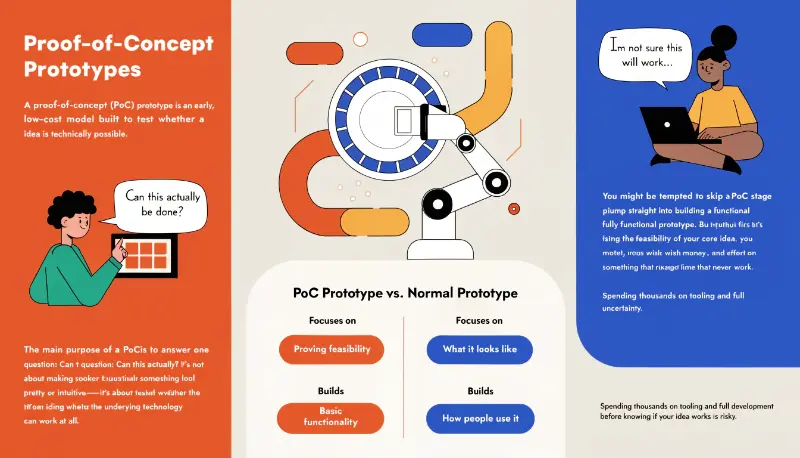
A proof-of-concept (PoC) prototype is an early, low-cost model built to test whether your core idea is technically possible before you invest in full development.1 It answers one question: "Can this actually be done?" A PoC focuses on proving feasibility, while a normal prototype shows what the product looks like and how people use it.2 Use a PoC when there is real technical risk or uncertainty.
I have watched many founders skip this step and pay for it later. I have also seen a simple PoC save a startup from a very expensive mistake. In this article, I will break down what a PoC is, what you need to build one, and how it differs from a regular prototype. Let’s keep going.
What is a Proof-of-Concept Prototype?
Many founders confuse "prototype" with "finished product." They try to build everything at once. Then they discover the core technology does not work. Now they have wasted months and money on features that sit on top of a broken foundation. This is a painful and common trap.
A proof-of-concept prototype is a small, limited model built to prove that your core idea can work. It sits between an idea and a finished product. It does not need to look nice or include every feature. It only needs to answer one key question: "Is this technically possible?" Once you have that answer, you can move forward with confidence.
Think of a PoC as a test, not a product. If your idea depends on a new sensor, a special motor, or a tricky mechanical movement, the PoC checks that one risky part. You strip away everything else. You focus only on the hardest technical challenge.
Here is a simple example. Say you want to build a smart water bottle that measures hydration through the water itself. The risky part is the sensor. A PoC would test only whether that sensor reads water levels accurately. It would ignore the bottle shape, the app, and the packaging.
Key traits of a PoC prototype
| Trait | Description |
|---|---|
| Scope | Very limited, core function only |
| Cost | Low, built fast and cheap |
| Goal | Prove feasibility, not looks |
| Users | Internal team, engineers, investors |
| Output | A yes/no answer on technical risk |
A PoC also helps your whole team agree on what matters. When engineers, designers, and clients see the same working test, expectations become clear. This saves arguments later.
What is Required for a Proof of Concept?
Founders often think a PoC needs a full lab and a big budget. So they delay it. Meanwhile, the biggest risk in their product stays untested. The truth is you need far less than you imagine. Waiting only makes the uncertainty worse and pushes real problems closer to your launch date.
To build a PoC, you need three things: a clear question to answer, the core components that carry the risk, and a simple way to measure success. You do not need a full design, packaging, or software. You just need enough to prove that the hardest technical part works. Keep it focused, cheap, and fast.
Let me break this down into practical steps you can follow.
1. Define the key question
Write down the one thing you are most afraid of. Is it battery life? Motor torque? Signal range? Your PoC exists to test that single risk. If you cannot name the risk, you may not need a PoC yet.
2. Gather only the critical parts
Buy off-the-shelf components when you can. Use development boards, standard sensors, and hobby parts. You are not building the final product. You are proving a concept. Speed matters more than polish here.
3. Set clear success criteria
Decide before you build what "success" looks like. For example: "The sensor must read within 5% accuracy." This keeps you honest and stops endless tinkering.
Here is how a PoC budget often compares to later stages:
| Stage | Typical Focus | Relative Cost |
|---|---|---|
| PoC | Core feasibility | Very low |
| Prototype | Look and user flow | Medium |
| EVT/DVT | Engineering validation | High |
| Mass Production | Scale and tooling | Very high |
A good PoC also gives you something powerful: proof for investors. When you show a working test, funding conversations change. You move from "I think this can work" to "Here, watch it work." That tangible evidence often unlocks money and approval faster than any pitch deck.
What Comes First, Proof of Concept or Prototype?
Here is where many teams get stuck. They build a beautiful prototype, show it to investors, and then discover the core function fails. All that polish was wasted. The order you build things matters more than most founders realize. Getting it wrong burns cash and time you cannot get back.
The proof of concept comes first. You prove the idea works before you build something that looks and feels like a product. A PoC removes technical risk. A prototype then builds on that proven foundation to test design, usability, and user experience. Building a prototype first is like decorating a house before checking if the ground is solid.
The logic is simple. Why spend money on a nice enclosure if you do not yet know the electronics inside will work? A PoC answers the scary question early. Then a prototype answers the design questions.
A simple order to follow
- Idea – You have a concept and a hypothesis.
- Proof of Concept – You test the riskiest technical part.
- Prototype – You build a version users can hold and try.
- EVT/DVT/PVT – You refine for manufacturing and scale.
Let me share a quick story. I once worked with a founder building a portable device with a new cooling method. He wanted to jump straight to a polished prototype. I pushed him to build a rough PoC first. It cost him a few hundred dollars. The cooling method failed at that stage. Because he learned early, he pivoted his design and saved months of work and tens of thousands of dollars.
There is one exception. If your technology is already proven and your challenge is only design or user experience, you can skip a formal PoC. In that case, a prototype comes first. But when real technical uncertainty exists, always prove the concept first.
What’s the Difference Between a POC and a Prototype?
Founders throw around the words "POC" and "prototype" like they mean the same thing. They do not. This confusion leads to wrong expectations, wasted budgets, and frustrated teams. When you ask a shop for the wrong thing, you get the wrong result. Knowing the difference saves you money and painful misunderstandings.
A POC proves that an idea works. A prototype shows how that idea works for users. A POC is a technical test focused on feasibility. A prototype is a user-facing model focused on look, feel, and experience. Simple rule: use a POC to prove it works, and use a prototype to show how it works for users.
Let’s make this crystal clear with a side-by-side view.
| Feature | Proof of Concept | Prototype |
|---|---|---|
| Main goal | Prove feasibility | Show user experience |
| Focus | Core technology | Design and usability |
| Looks | Rough, unfinished | Close to real product |
| Audience | Engineers, investors | Users, testers, investors |
| Question answered | "Can it be done?" | "How does it work for people?" |
| Cost | Low | Medium to high |
A practical example
Imagine you want to build an app-connected device that uses a new AI model and a live data feed. A POC would test whether the AI model and the data feed can work together reliably. That is the risky, uncertain part. A prototype would let users click through the app, feel the device, and give feedback on the experience.
Both tools matter, but they serve different jobs. The POC removes doubt about the technology. The prototype removes doubt about the design and the user journey. Smart founders use both in the right order.
When you may skip the POC
You can skip a formal POC when the technology is well understood and proven. If your product is a minor improvement on an existing item, a prototype alone may be enough. But if you rely on new tech, complex integrations, or tough performance targets, a POC protects you. It reduces uncertainty and helps you make better decisions before spending big.
Conclusion
A proof-of-concept prototype answers one vital question: "Can this actually work?" Build it first when you face real technical risk. Then move to a prototype to test design and user experience. This order saves money, avoids painful mistakes, and speeds up your path to market. Start small, prove the hard part, and scale with confidence. Ready to test your idea? Build your PoC today.
-
"Proof of concept", https://en.wikipedia.org/wiki/Proof_of_concept. This definition aligns with established software engineering terminology where a proof-of-concept demonstrates the feasibility of a concept or theory, typically with minimal investment in resources before proceeding to full-scale development. Evidence role: definition; source type: encyclopedia. Supports: the standard definition and purpose of proof-of-concept prototypes in product development. Scope note: The source may define PoC more broadly across industries rather than specifically for startup contexts ↩
-
"Proof of Concept vs Prototype: What’s the Difference?", https://www.youtube.com/watch?v=3rDsu8kvgJM. Product development frameworks distinguish between proof-of-concept phases that validate technical feasibility and prototype phases that demonstrate user-facing functionality and design, though terminology and boundaries between these stages vary across methodologies. Evidence role: general_support; source type: research. Supports: the functional distinction between proof-of-concept and prototype stages in product development methodology. Scope note: Different development frameworks may define these terms with varying levels of overlap or use alternative terminology for similar concepts ↩