
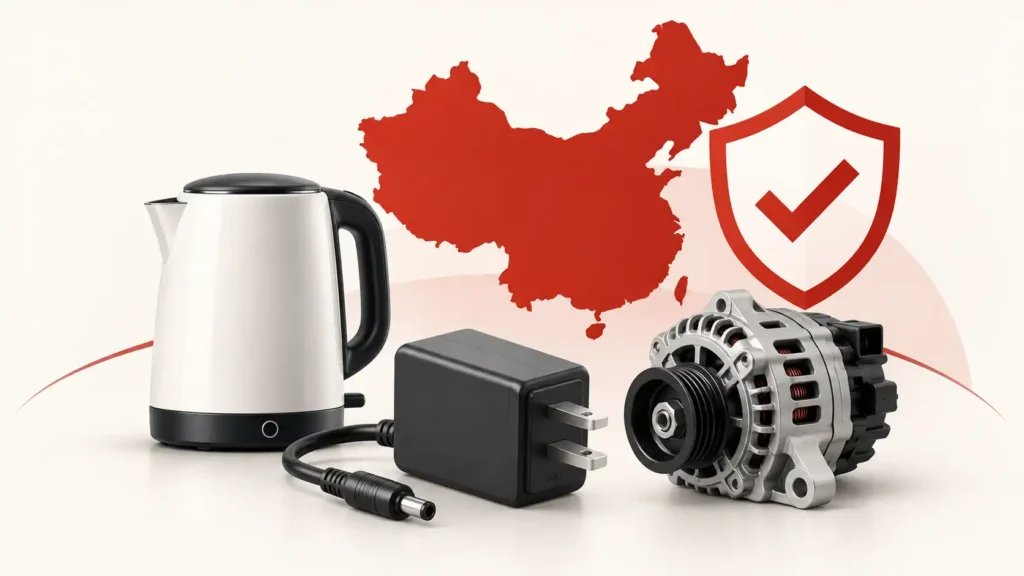
CCC is China’s mandatory conformity-assessment system for certain product categories. In practice, manufacturers and importers must prove their products meet China’s national safety standards through testing, factory inspection, and certification before those products can legally enter or be sold in the country. If your product falls within its scope, you cannot legally import, sell, or distribute it in China without a valid CCC certificate and the required CCC mark.
The categories covered are broader than most companies expect, and finding out about the requirement after production planning has already started can delay market entry by months.
This article covers which products require CCC, how the certification process works, what testing and documentation are involved, what the marking rules require, who is responsible, and where hardware product companies most often go wrong.
What Is CCC Certification, and Which Products Does It Cover?
CCC certification is the process used to test, inspect, and officially approve a product as meeting China’s national safety standards. A product that passes receives a CCC certificate and is authorized to carry the CCC mark. These are the two things Chinese customs, buyers, and regulators check when a hardware product enters the Chinese market.
CCC stands for China Compulsory Certification, also called 3C certification. The Chinese government introduced the system in 2002 by combining two older safety programs: CCIB, which covered imported goods, and CCEE, which covered electrical products. China made this change as part of its World Trade Organization commitments.
The China National Certification and Accreditation Administration (CNCA) runs the CCC system. It sets the rules, maintains the official product catalogue, and authorizes the bodies that carry out certification work. The China Quality Certification Centre (CQC) is designated by CNCA to process applications and handles most product categories. The China Certification Centre for Automotive Products (CCAP) handles vehicles and automotive parts specifically.
If your hardware product is listed in the official CCC catalogue, it must be tested, inspected, and certified before any of the following can legally take place:
- Import into China
- Sale in the Chinese market
- Commercial distribution or use
Selling a covered hardware product without certification, or placing the CCC mark on a product that has not been properly certified, carries real consequences, including fines, product seizure, and removal from the Chinese market.
Products That Currently Require CCC Certification
The current official CNCA list covers 17 product categories and 106 product types (confirmed by CNCA’s April 2026 implementation rules summary, per SAMR Announcements No. 36 of 2023 and No. 9 of 2024). The U.S. Department of Commerce estimates that about 20% of U.S. exports to China fall within this list.
| Category | Example Products |
|---|---|
| Wires and cables | PVC insulated cables, rubber insulated cables |
| Circuit switches and connectors | Wall switches, power sockets, plugs, fuse links |
| Low-voltage electrical equipment | Circuit breakers, residual current devices |
| Small motors and power tools | Fan motors, electric drills, angle grinders |
| Household appliances | Refrigerators, air conditioners, washing machines |
| Electronic products | Computer monitors, power adapters, speakers, power banks |
| Lighting equipment | LED lamps, desk lamps, fluorescent lights |
| Vehicles and safety parts | Cars, helmets, vehicle safety belts |
| Agricultural machinery | Tractors, pesticide sprayers |
| Fire protection products | Emergency lighting, fire extinguishers |
| Building materials | Safety glass, interior wall coatings |
| Children’s products | Toys, baby strollers, children’s bicycles |
| Explosion-proof equipment | Explosion-proof lighting fixtures |
| Gas appliances | Gas cookers, water heaters, gas detectors |
| EV charging equipment | New energy charging cable assemblies |
| Electric welders | DC arc welding machines, TIG welding machines, MIG/MAG welding machines, plasma arc cutting machines |
| Security and protection products | Intruder alarm systems, access control equipment |
This list has changed since 2002. Portable power banks, EV charging cables, and electric bicycle helmets were added in later updates.
How Do You Know Whether Your Product Requires CCC?
Starting by looking at the catalogue is the way to go, but a product’s name won’t provide a reliable answer. The approach that actually works is this:
Find your product category in the official CNCA catalogue over at cx.Cnca.Cn
Read the scope description – it will tell you precisely what is included and what is excluded from that particular category
Pull out the certification rule for your specific product type
Check whether your exact product fits right in with what that rule describes
An item called ‘electronic device’ or ‘battery product’ could either need a CCC or might not – all dependent upon what the actual official scope indicates – not the commercial name.
CCC Certification Exemptions and Available Routes
Here are two scenarios that get frequently mixed up, and the difference is key.
If your product doesn’t appear in the CCC catalogue then no certificate is necessary and there’s no need to file an exemption application either.
If however your product does appear in the catalogue but meets the conditions under which it’s exempted, then a formal exemption may be requested. These scenarios include:
- Products that are being used solely for research purposes or in a laboratory setting
- Components brought into the country to evaluate manufacturing technology
- Products imported strictly for repairing a client’s gear
- Items intended for display purposes in commercial settings but won’t be resold
- Imports that are temporary and will subsequently be re-exported
Every exemption case needs a completed application along with some supporting documentation – it won’t be given automatically.
Some items listed in the catalogue will also qualify for a self-declaration route whereby the manufacturer files the essential declaration instead of engaging in third party certification. Whether your product actually qualifies is determined by its certification rule.
The CCC Certification Process Explained
There isn’t just one process applicable to all products. The CNCA regularly puts out certification rules for the various types of products and every one sets out the details of the procedure – what gets put to the test, what the factory inspection entails and the duration of time that the certificate remains valid.
Read through your product’s rule first thing.
Who Can Submit the CCC Application
The manufacturer, seller, or importer can apply for CCC. When the seller or importer applies on behalf of the manufacturer, you need additional documents to explain the relationship between them. The same applies when one company designs a product and another company manufactures it.
Main Steps in the CCC Certification Process
- Submit your application to a CNCA-authorized certification body with your product details, company information, and required documents.
- Send product samples to a CNCA-designated testing lab in China. The lab tests them against the applicable GB standards for your product type.
- Factory inspection: An auditor visits your production facility to verify that your setup can consistently produce the product submitted for testing.
- Certificate issuance: The certification body reviews the results and, if everything meets the requirements, issues your CCC certificate.
Your certificate identifies the applicant, manufacturer, product name and model, applicable standards issue date, validity period, and certification body. Chinese customs, buyers, and distributors use this information to verify that your product is certified.
What Is Changing About CCC Routes Right Now?
This matters if you are planning certification in 2026. Sixteen product types are moving from the self-declaration route to mandatory third-party certification, starting January 1, 2027. Certification bodies began accepting applications for these products on July 1, 2026. If your product is one of the 16 and you currently hold a self-declaration, you need to convert it to a full certificate by December 31, 2026.
This change affects those 16 product types only. It is not a system-wide change.
CCC Testing, Inspection, and Documentation Requirements
Testing, factory inspection, and documentation are three separate requirements. Meeting one does not automatically satisfy the others.
CCC Product Testing Requirements
Your product is tested against China’s national safety standards, called GB standards, that apply specifically to your product type. The applicable standards are defined in your certification rule.
Testing must take place at a lab that CNCA has authorized for your product category. Not every lab in China qualifies. If samples go to an unauthorized facility, the results will not be accepted, and testing will need to be repeated. There is no standard test package for every CCC product. What gets tested depends on the GB standards that apply to your product.
What Does the Factory Inspection Check?
Lab testing checks whether a sample of your product meets the required standards. The factory inspection checks whether your production setup can reliably produce that product at the same level every time.
An auditor visits the facility where the final quality check takes place and reviews:
- Whether quality control systems match what was described in the application
- Whether products coming off the production line are consistent with what was tested and certified
- Whether the required controls are being followed on the production floor

What Documents Do You Need?
Documentation requirements vary by product and certification rule. Generally, the application package covers:
- Application information and company details
- Product technical, specifications and identification
- Manufacturer and production facility information
- Test materials and reports
- Contracts between the applicant and manufacturer where applicable
- Any additional documents the certification rule specifies
Your product’s certification rule tells you what is needed. There is no universal document checklist.
What Happens If the Product Changes After Certification?
If anything changes about a certified product, such as a component being swapped, the design being updated, or a supplier changing, those changes must be reported and approved before they are made. Some changes require new testing in China. Moving production to a different facility usually means the new location needs its own certification process, or at minimum, a separate factory inspection.
CCC Mark Rules and Compliance Responsibilities
What Is the CCC Mark?
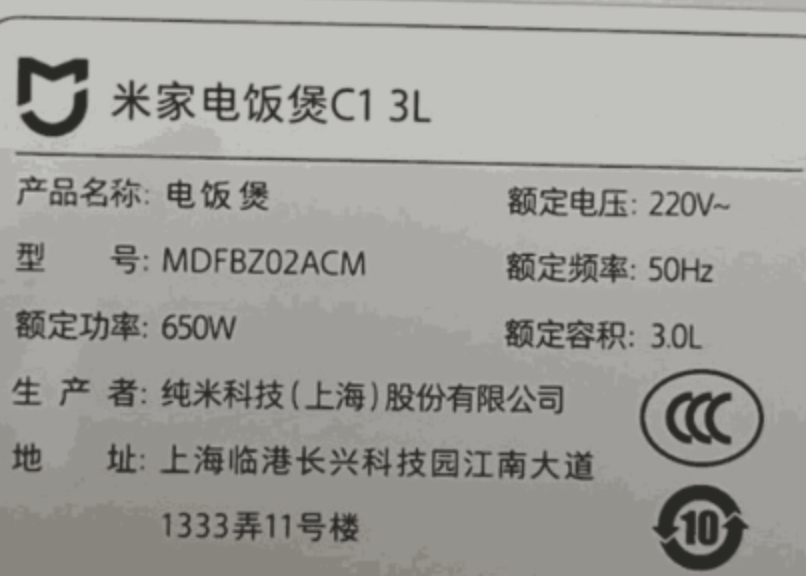
The CCC mark is a legally controlled mark under Chinese regulations, not a quality badge that a company can choose to display. Placing it on a product without a valid certificate carries legal penalties, including fines and product seizure. The CCC mark must be applied in accordance with the current marking requirements and the implementation rules for the applicable product category. Any required product or manufacturer traceability information depends on the specific certification requirements.
How Must the Mark Be Applied?
The CCC logo must appear on the product together with the factory code that identifies the production facility. Marking requirements, including size, placement, and marking method, vary by product type and are defined in the applicable certification rule.
A product with a missing factory code, the wrong mark size, or incorrect placement can be stopped at Chinese customs even when a valid certificate exists.
From January 1, 2024, electronic CCC certificates have the same legal standing as paper certificates. For products within the CCC traceability QR-code pilot scope, newly certified products are subject to the QR-code requirement from March 1, 2026. The requirement will extend to all certified products within the applicable pilot categories from March 1, 2027, subject to the official transition arrangements.
Manufacturer’s Ongoing CCC Compliance Responsibilities
Receiving the, certificate does not end the manufacturer’s obligations. Ongoing responsibilities include:
- Keeping every production run consistent with the certified product
- Maintaining the quality controls used during the factory inspection
- Cooperating with annual follow-up inspections
- Getting approval before making any changes to the product, components, or production process
- Keeping all required records
- Using the CCC mark only according to the applicable rules
Importer Responsibilities Under CCC Certification
The importer has its own obligations:
- Confirming whether the imported product falls within CCC scope before the shipment moves
- Verifying that the product has been certified and that the certification is current
- Checking certificate and marking information on incoming goods
- Providing required documentation when acting as the certification applicant
Products arriving at Chinese customs without valid certification or correct marking can be held or returned regardless of where they were manufactured.
How Long Is the Certificate Valid?
CCC certificates are valid for five years. If a product stops meeting the required standards, the certificate can be suspended or cancelled. The renewal process should begin at least three months before the expiry date.
Common CCC Compliance Mistakes Companies Make
Assuming every product sold in China needs CCC. Only products on the official catalogue require CCC. If your product is not on the list, you do not need a certificate.
Using the product’s name to decide whether CCC applies. The official scope description and certification rule determine this, not the name used for the product on an invoice or brochure.
Assuming all CCC products follow the same process. Each product type has its own certification rule. With 16 types moving from self-declaration to third-party certification by January 2027, not knowing whether your product is one of them is a costly assumption.
Treating lab testing as the only requirement. Testing is only one part of the process. Factory inspection and documentation are also required.
Assuming a supplier’s certificate covers your product. A CCC certificate identifies the applicant, manufacturer, production facility, and product model. If any of these do not match what you are importing or selling, that certificate does not cover your product.
Applying the mark without following the rules. Using the wrong size, leaving out the factory code, or marking the product before the certificate is issued can create problems at Chinese customs.
Changing the product without checking first. Design updates, component changes, and supplier switches can have reporting and approval requirements. Making these changes without following the required process can cancel an existing certificate.
Relying on outdated articles or guides. The current scope covers 17 categories and 106 product types. The CNCA and SAMR platforms are the only reliable current sources.
Getting CCC Certification Right Starts at the Production Stage
CCC certification does not begin when your product reaches Chinese customs. It begins at the design and production stage. Whether your components meet the applicable GB standards, whether your production setup can consistently reproduce what gets submitted for testing and whether your factory passes inspection, all of that is shaped by decisions made before the certification process starts.
If your hardware product is approaching the enclosure design and production stage, StartupMolding works with manufacturers at exactly this point. Its services cover:
- Enclosure DFM review
- Prototype injection molding
- Mold design and manufacturing
- Production injection molding
You can share your enclosure CAD files, component and layout information, and production requirements with StartupMolding for a manufacturability review.
Frequently Asked Questions
If my product doesn’t need CCC, how do I prove that to a Chinese buyer or customs officer?
A CCC Investigation Letter formally confirms that a product has been reviewed and found to be outside the certification scope. Some sectors, particularly automotive also use negative certificates for this purpose. Either document removes doubt at customs and with buyers before a shipment gets flagged.
How long does it typically take to get CCC certification for the first time?
The process often takes approximately four to five months, but the actual timeline depends on the product category, testing requirements, factory inspection, documentation, and whether any corrective action is required. Plan for this before committing to a launch date.
Can a foreign company apply for CCC directly, or does it need a Chinese entity involved?
A foreign manufacturer can apply directly. However, when the applicant is outside China, additional documentation is typically required to establish the relationship between the foreign applicant and the production facility. Some companies use a Chinese agent to manage the process, but it is not a legal requirement.
What happens if a product is held at Chinese customs for a CCC issue?
Products subject to CCC requirements may be detained by customs or the relevant regulators if the required certification is missing. The final handling may depend on the circumstances and applicable regulations and could include corrective action, return, confiscation, or destruction. Importers should confirm the applicable CCC requirements before shipment rather than assuming certification can be completed after arrival.